

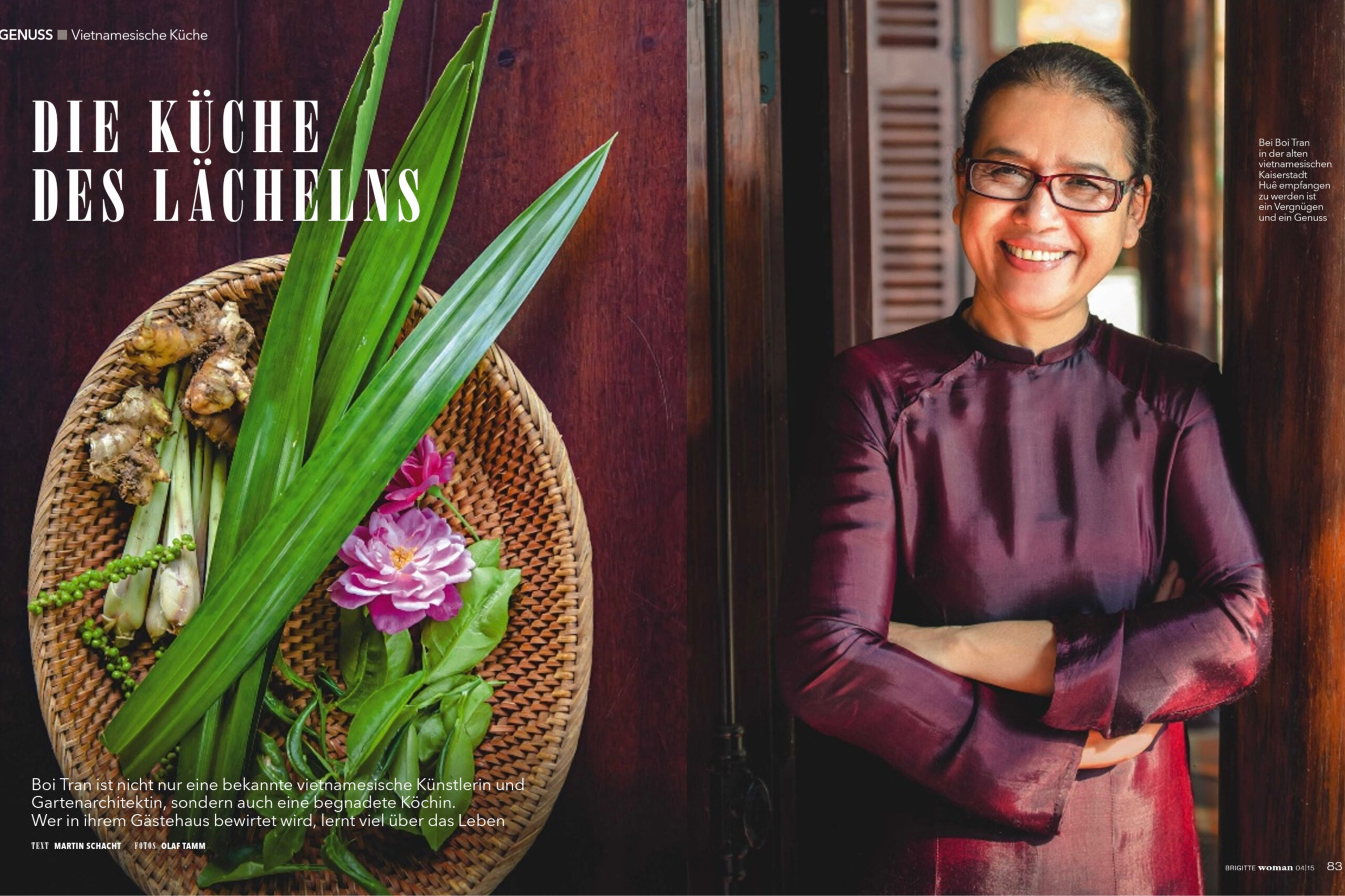
The Kitchen of Smiles
Brigitte Woman
Boi Tran is not only a distinguished Vietnamese artist and garden architect, but also a gifted cook. To be received by her in the former imperial city of Hue is both a pleasure and a discovery. Within a secluded garden of lotus ponds and wooden architecture, everything has been shaped by her own hand. Here, cooking becomes more than craft; it is an extension of life, rooted in the refined traditions of Hue and guided by balance, precision, and memory. What emerges is not simply a meal, but a quiet harmony, where art, space, and gesture come together as one.
Boi Tran is not only a well-known Vietnamese artist and garden architect, but also a gifted cook. Whoever is hosted in her guesthouse learns much about life. To be received by Boi Tran in the old Vietnamese imperial city of Hue is a pleasure and a delight.
On the bridge over the river called the “River of Fragrances,” there is dense traffic. Rickshaw drivers, ancient trucks, buses, and countless mopeds, with which astonishing quantities of goods are transported. Many women are driven through the Vietnamese city of Hue sitting side-saddle, most with gloves, in high-collared jackets. Fair skin has always been the ideal of beauty in Vietnam, and this applies especially to Hue.
The old imperial residence is said to be particularly conservative. And perhaps it is no coincidence that this is the homeland of Boi Tran. A woman who unites present and tradition, in her work as a cook, artist, and architect. The cuisine of Hue is considered the best in the country. According to a legend, the former rulers refused to eat a dish more than once a year. The court chefs therefore always combined ingredients into new creations in decoratively arranged miniature portions. Even today, this food culture is typical for life in Hue, and Boi Tran is an ambassador of this culture.
Above the city rises a hill, on which lies a garden that once bore the name “Royal Garden.” Behind high vine-covered walls and an imposing wooden gate, the artist has created here an enchanted world of lotus ponds, bamboo groves, and elaborate structures. A narrow path, lined with frangipani trees, meanders past an ancient wooden monastery to a staircase that leads up to a villa, on whose veranda Boi Tran herself receives us. Madame wears a silk ao dai, that traditional combination of wide-cut trousers and a tight, slit over-garment, which makes Vietnamese women appear extraordinarily elegant.
Boi Tran knows how to stage perfectly, not least herself: everything one sees here, she has achieved by herself. The house she designed with her own hands, as well as the garden. The antique wooden buildings that adorn the garden she collected from other regions and had rebuilt here. “People said I was crazy. After all, I never learned to work as an architect. But I took a few craftsmen and simply began.” Today she supervises large garden projects; she also has a studio, and she runs her restaurant here, in which she preserves the culinary tradition of Hue. Without work, she says, she would become melancholic. Only later do we understand what she means.
The next morning at five, it is still dark, we get to know a completely different Boi Tran. The elegant lady of yesterday now trudges in trousers and rubber boots through the market, forcefully making her way through a tangle of muddy passages, lit by spotlights and neon lights, through which carts are pushed with loud calls, loaded with baskets full of shrimp, fruit, vegetables, or flowers. Slippery catfish, pickled bamboo shoots in large plastic tubs, frogs. And in the middle of it Boi Tran, bargaining and laughing, pressing an armful of flowers into her assistant’s hands, bags of vegetables or shrimp. Carefully she examines the fish and flips the gills with a bamboo stick. “The eyes must be clear and the gills still pink. Then they are fresh.”
She is also selective with fruit and vegetables. Confidently she grabs a bunch of mint to smell it; a basket of strawberries does not meet her taste, the vendor must take it back. “Stored too long,” she judges after trying one, “no aroma anymore.” She recognizes the right ripeness of a mango by gentle thumb pressure. But before Boi Tran takes a whole basket, she has one fruit cut open. “A perfect orange,” she beams, “and no dark spots. At the cut surface a little juice must emerge, then they are sweet, but not overripe.”
Cooking for Boi Tran is more than just a profession. It is also more than a passion. It is part of her life and at the same time her way of coping with life.
As a young woman she experienced the nearly 20-year Vietnam War, which ended in 1975. At that time she, daughter of a once wealthy, court-related family from the South, stood with nothing, after communist North Vietnam had defeated South Vietnam. “I know what it feels like to be hungry. I know what it feels like to be hungry. I know what poverty and death mean. These are not mere ideas for me, I feel that deep inside. After the war I weighed only 38 kilos and had nothing to eat.”
Boi Tran does not like to talk about this time. When asked how she managed to free herself from poverty, she only answers: “I always cooked. Food was my passion. Because we had nothing during the war.” Behind these sparse sentences lies a remarkable biography. A woman who builds her own existence, is very successful, even divorces, as Boi Tran did, is unusual in Vietnam. “My life,” says Boi Tran, “was somewhat difficult, to put it mildly.”
Some years ago came the worst blow of fate. Her grown son drowned after saving several children from a river accident. She has erected a shrine for him. Large floor vases with yellow chrysanthemums frame a kind of altar with family photos. “Vietnamese women are very tough, but one must always look behind the smile,” says Boi Tran.
Her garden is like this smile. A miracle of colors and scents; here also grow the spices she uses for her wonderful cuisine: coriander, pepper, lemongrass, kaffir lime. Right behind the beds stands Boi Tran’s studio. As the only student of the painter Nguyễn Trung, she has also developed her own style in art. Sometimes she works 15 hours, during which she forgets everything around her. This meditative aspect is one way she copes with grief; another lies in the motifs: again and again one finds female figures holding two children by the hand.
Boi Tran also has a daughter. She lives in the USA, where she has started her own family. “I often spend a few months in the USA, and every time I return, I miss my daughter and my little granddaughter. But I still have much to do here.” Thirty employees work for Boi Tran; she is responsible for them as well. For most women in Vietnam, family is the most important, and food plays a significant role in living together. And because her family lives abroad, Boi Tran cooks with the same love for her guests. “For me, cooking is not work, but pure pleasure,” she says, while spreading fine nets of rice paper in which she skillfully wraps the ingredients for her tiny spring rolls.
Spring rolls are something like the national dish of Vietnam; they are eaten raw, fried, or deep-fried. The fillings vary by region and season. They are fried only briefly, but very hot, so they become crispy outside while gently cooking inside. This is important to preserve the aroma of the many herbs.
“Vietnamese cuisine is actually quite simple,” explains Boi Tran. “In Hue we also have a French influence from colonial times. Sometimes I even use cheese, which does not really exist in Asian cuisine, to refine sauces. I mix my family’s traditional recipes with my own ideas.”
That she loves to experiment can be seen when she seasons sauces. Here something is removed, there something added, it is as if she were painting a picture. Many herbs are added only after cooking. “Then they do not become mushy or bitter and retain their aroma,” she explains, while flattening a stalk of lemongrass with a cleaver. Everything appears simple: confident, flowing movements, graceful like a dance. A few gestures to combine the ingredients, then she carefully places the two shrimps into the soup and says softly: “Please try.”
We sit on the veranda while eating. We taste contrasts and harmony, everything is different, everything belongs together. We hear crickets chirping and frogs croaking in the lotus pond, the full moon casts long shadows, and for a moment it seems to us as if Boi Tran’s world were a puzzle whose final piece we have just found.