


A Letter by Dr Volker Wissing, General Secretary, German Minister of Digital Affairs and Transport, or The Civility Of Memory
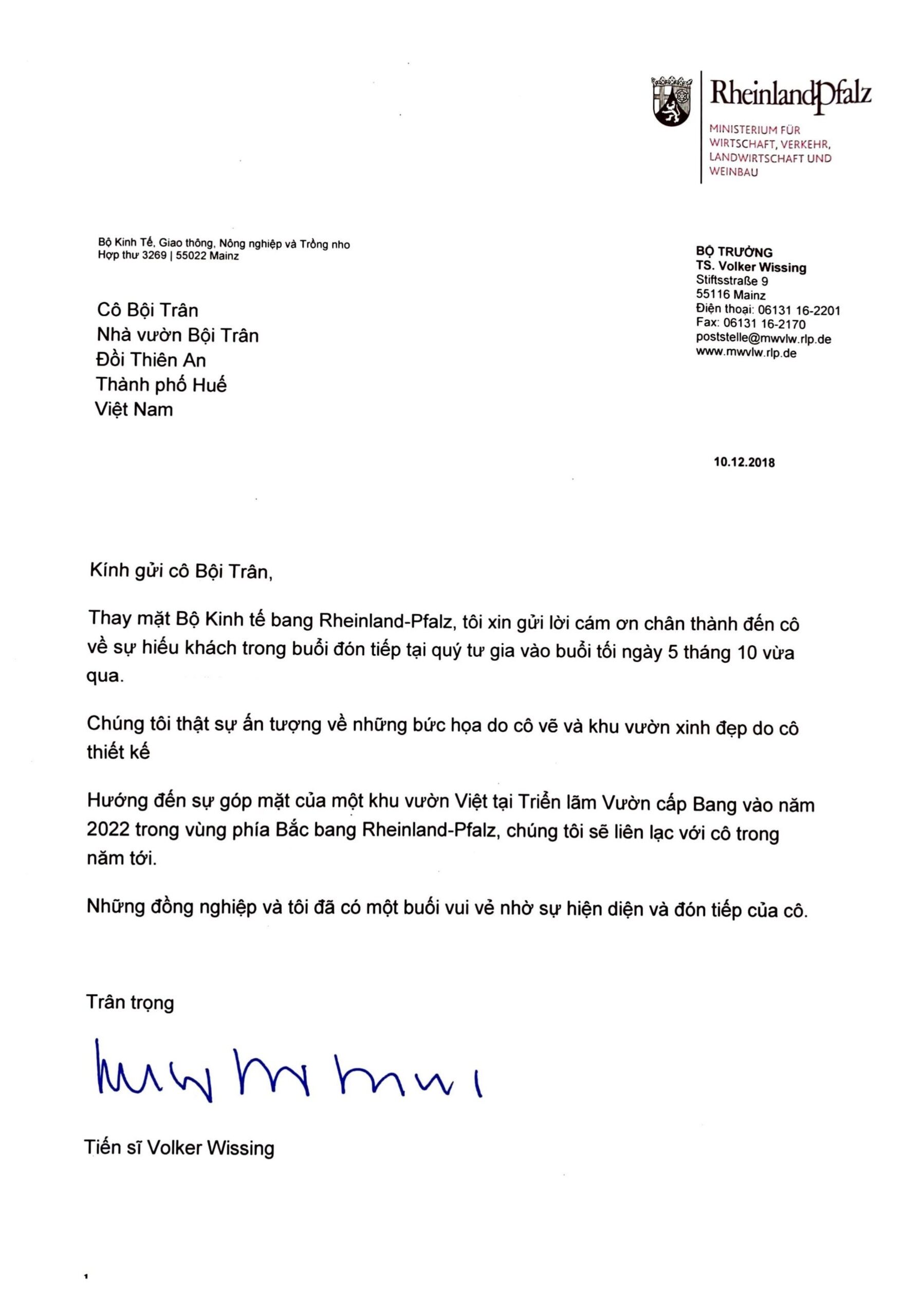
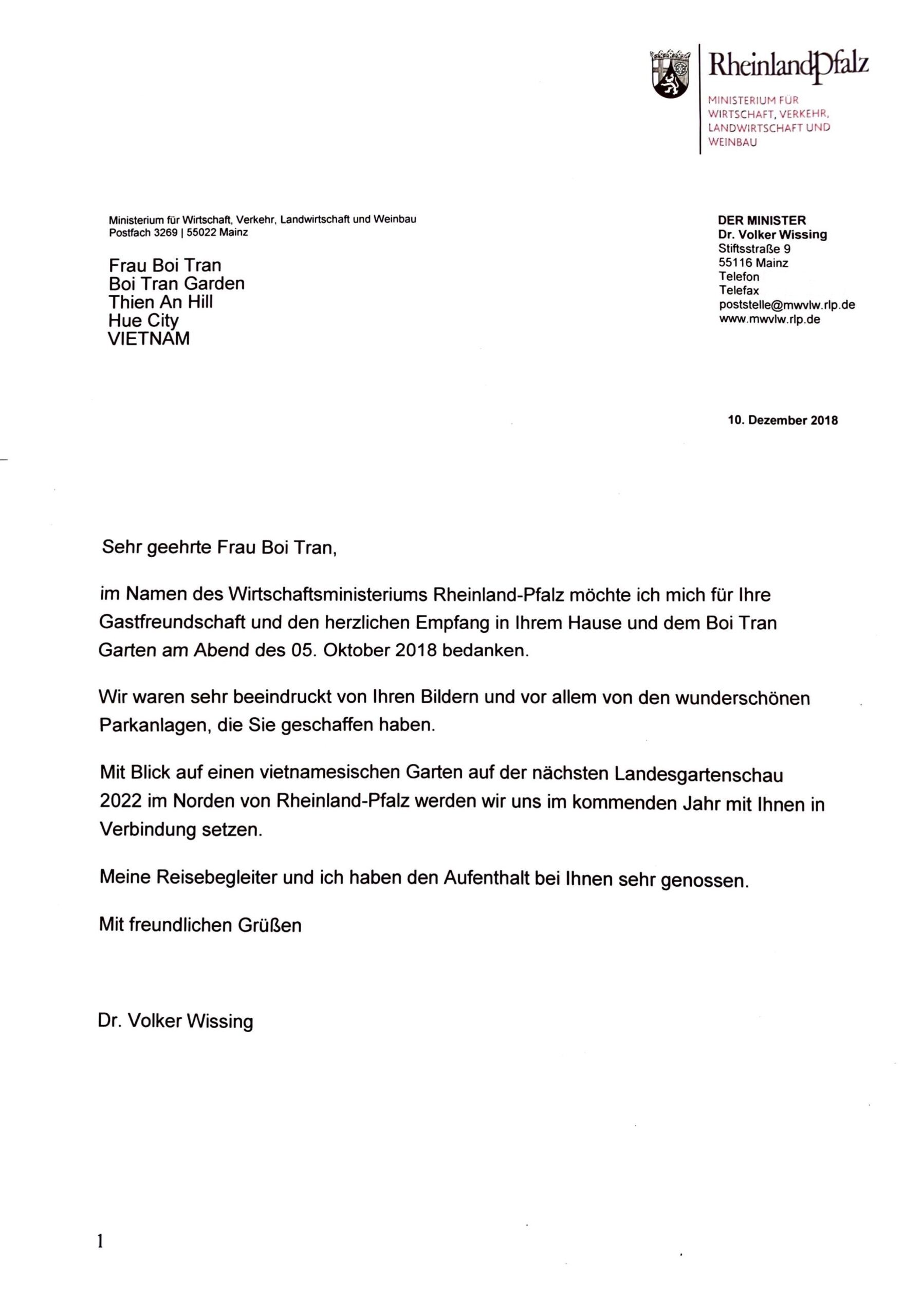
Written on 10 December 2018 after an evening at Boi Tran Garden, Dr. Volker Wissing’s letter belongs to the tone: a brief official correspondence that preserves, with uncommon clarity, how art and hospitality may linger in diplomatic memory.
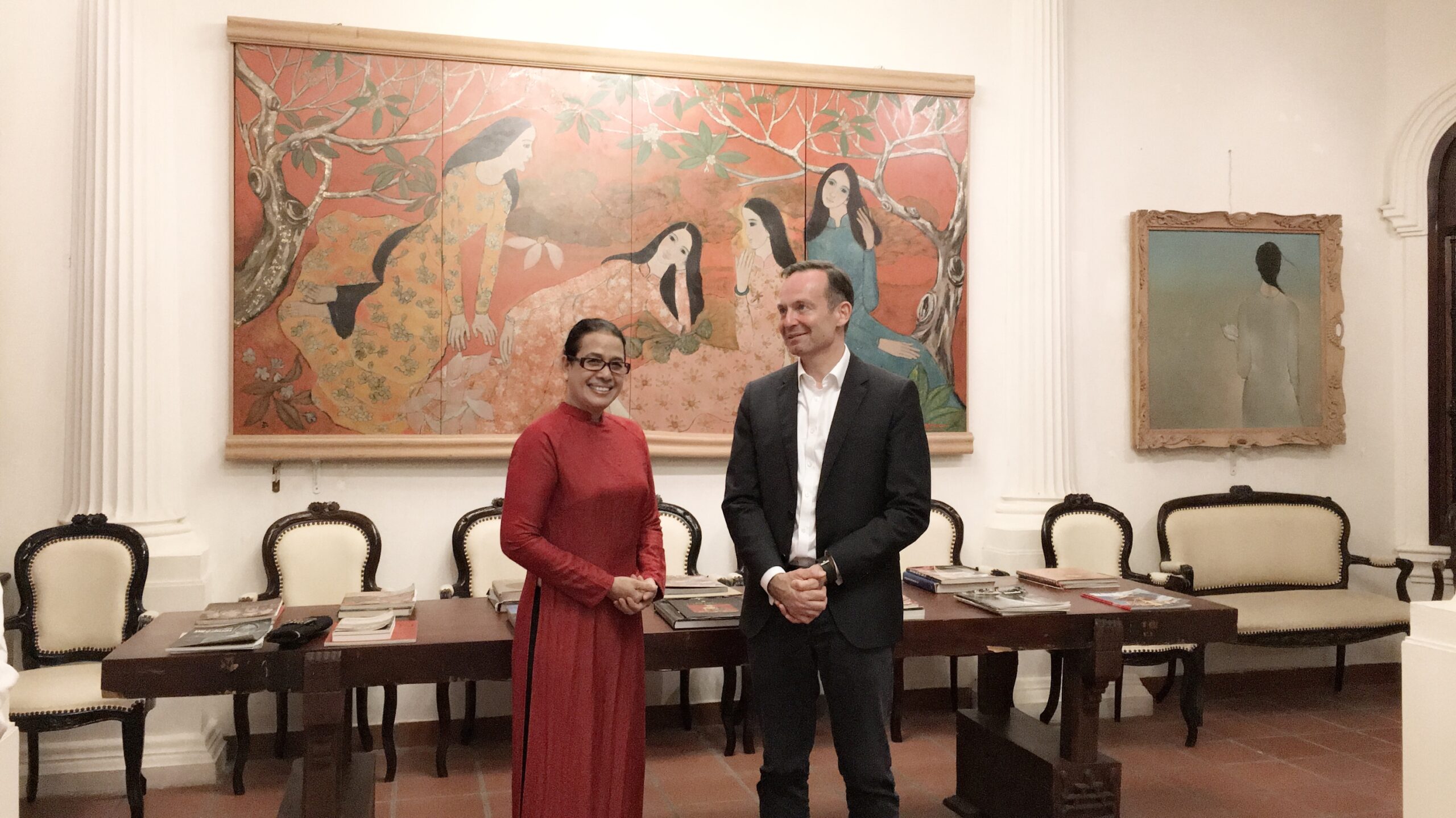
Letters of thanks are often numerous and soon forgotten. Yet from time to time, a document of modest form acquires another life: not through grandeur, but through what it quietly records. Such is the case with the letter sent on 10 December 2018 by Dr. Volker Wissing to Artist Boi Tran after his visit to Boi Tran Garden, Thiên An Hill, Huế.
At the time of writing, Dr. Wissing was serving as State Minister for Economics, Transport, Agriculture and Viticulture of Rhineland-Palatinate. He would later become General Secretary of Germany’s Free Democratic Party, and subsequently Federal Minister of Digital Affairs and Transport. Public office gives context to the letter. It does not give it value. Its true importance lies in the response of a cultivated guest to a place that had left an impression.
Addressed simply to “Mrs Boi Tran,” the letter thanks her, on behalf of the Rhineland-Palatinate Ministry of Economics, for the hospitality and warm welcome extended on the evening of 5 October 2018. The phrasing is measured, formal, and unmistakably sincere.
He writes:
“We were very impressed with your paintings and especially the beautiful garden that you have created.”
This sentence deserves attention. Paintings are acknowledged first, yet the emphasis turns gently toward the garden. It suggests that what was encountered in Huế was not merely an artist’s work upon canvas, but an expanded practice in which landscape, architecture, atmosphere, and human presence formed a single composition.
Boi Tran Garden has long occupied such a singular position. It is at once residence, studio, exhibition space, and cultivated retreat. The visitor does not encounter objects alone, but relations between objects: light upon tile, silence between trees, proportion between house and pond, the measured transition from exterior calm to interior intimacy. In this sense, the garden may be read as a work no less authored than a painting.
The letter then turns, with characteristic precision, toward future cultural exchange:
“Towards the presence of a Vietnamese garden on the Federal Horticultural Show in the north of Rhineland-Pfalz in 2022, we cordially invite and get in touch with you in the coming year.”
Behind the administrative phrasing lies something more revealing. The idea of a Vietnamese garden presented in Germany indicates that what had been seen in Huế was understood not as private charm, but as a cultural form capable of translation across borders, approaching the world.
Near the close, the letter becomes more personal:
“My companion and I really enjoyed the contented evening spent with you thanks to your presence and kindness.”
Such language is rare in official correspondence. One may praise an event, commend a programme, or thank a host. To identify presence itself as the source of an evening’s contentment is subtler. It recognises that civility is not produced by protocol alone. It proceeds from character.
Seen today, the letter functions as a small but eloquent archival piece. It records no treaty, announces no policy, and seeks no publicity. Yet it preserves something more enduring: the evidence that a garden in Huế, shaped by an artist’s intelligence and generosity, remained vivid in the mind of a visiting statesman weeks after he had returned home.
At Boi Tran Garden, diplomacy required no stage. It found expression in the older arts of welcome, attention, and memory.