
Ravenel, Vietnamese Modern Art, or the Architecture Of Elegance and the Discipline of Beauty in Boi Tran
Ravenel Taiwan
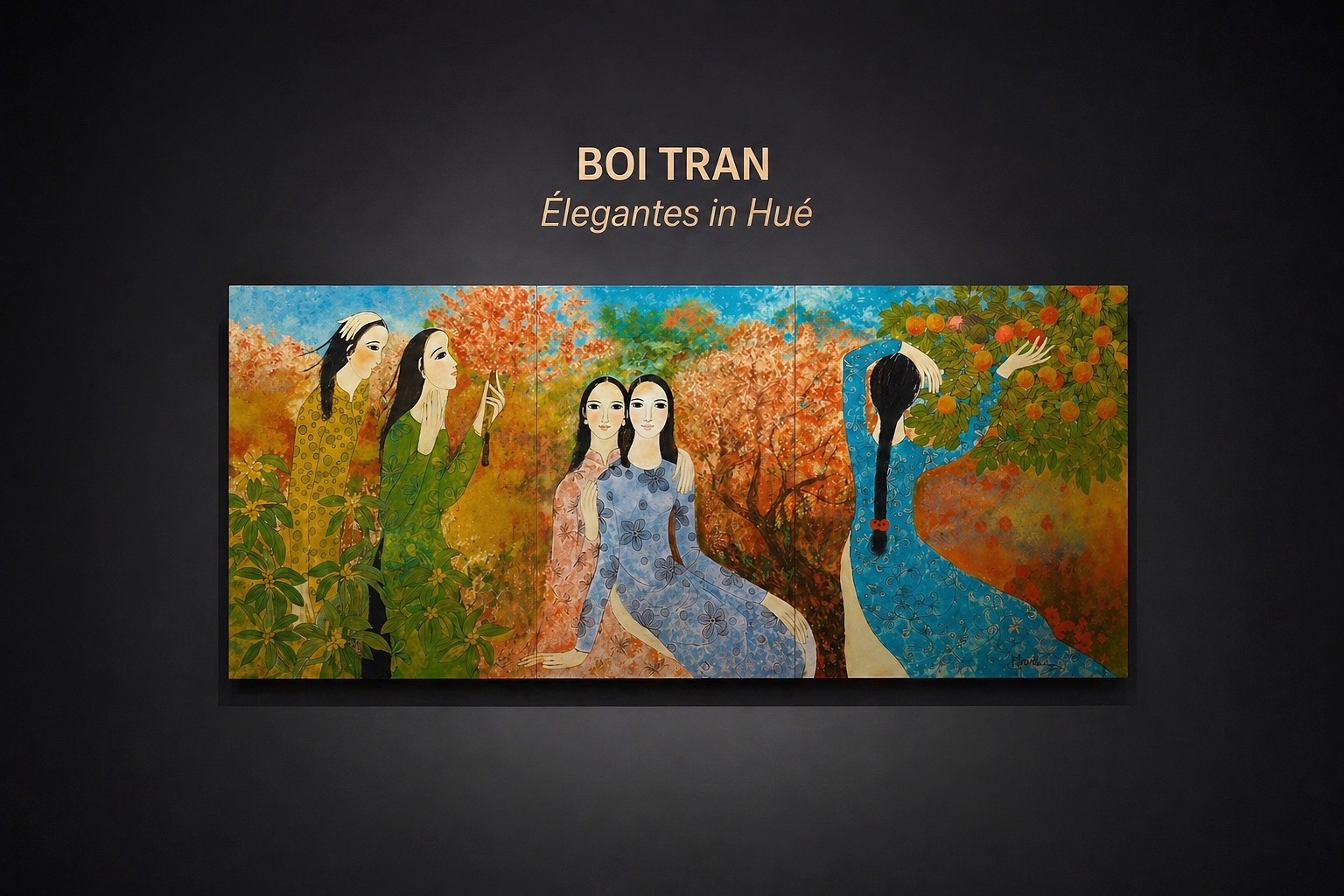
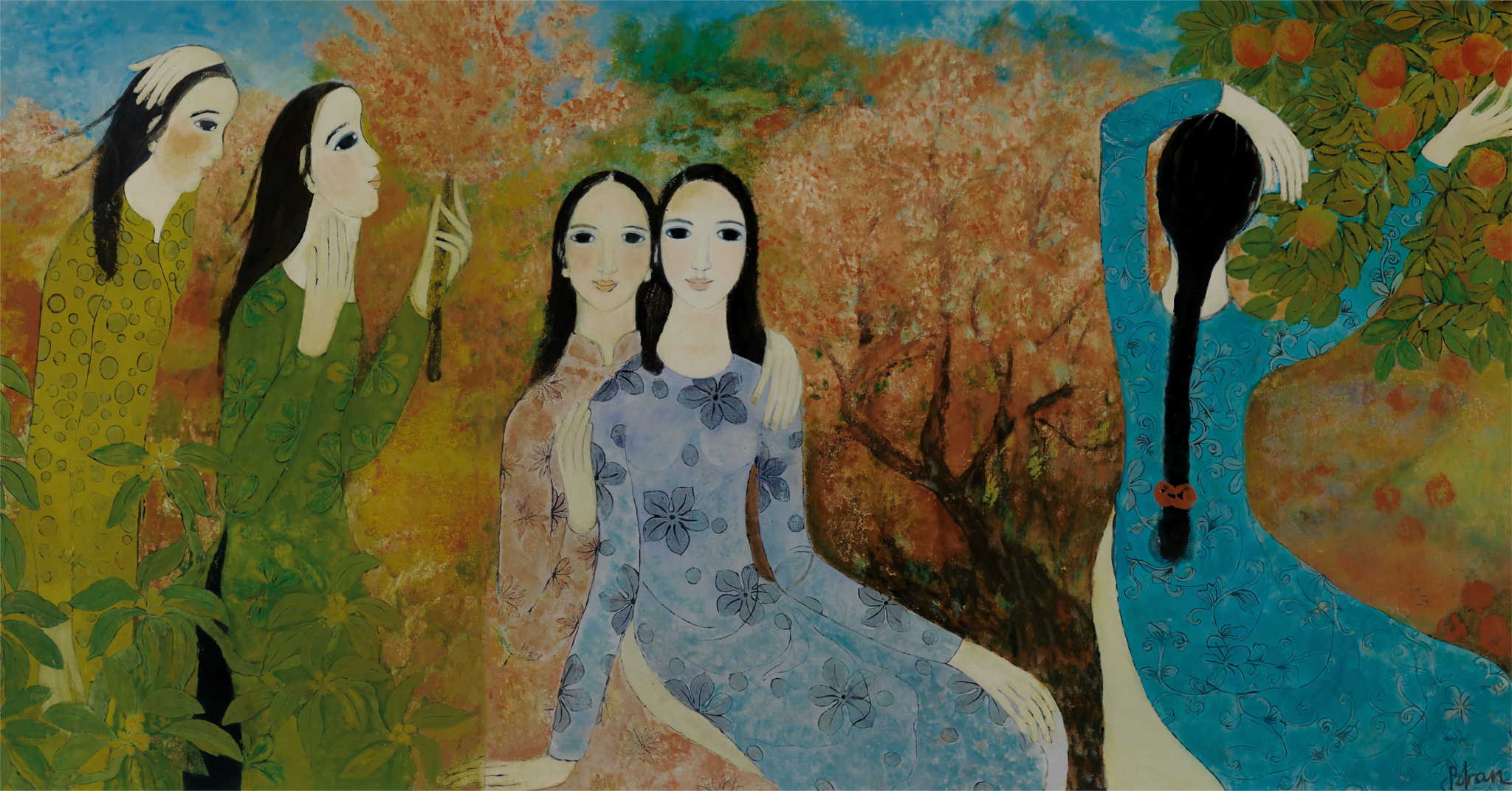
Boi Tran is one of the few outstanding Vietnamese female artists. Her style is influenced by her teacher, Trung Nguyen. She also worked as Nguyen's model, serving as a source of creative inspiration for the artist. Boi Tran's Elegant in Hue trilogy is presented in a classical European triptych form. They depict a group of beautiful goddesses strolling, sitting and dancing in a glorious garden. The composition of the piece is extraordinary and spectacular.
In its Select Modern & Contemporary Art sale, Ravenel placed Vietnamese modern art within a broader regional and historical framework. This was not merely a presentation of individual works. It was an attempt to situate a visual language shaped by centuries of cultural intersection, between inherited traditions and external influences, between continuity and rupture.
Vietnamese modern art emerges from a complex history. From the long proximity to Chinese culture, to the decisive transformation brought by French colonial education, particularly through the École des Beaux-Arts de l’Indochine, artistic practice evolved within a space of negotiation. Western academic principles were introduced. Yet silk and lacquer persisted. What followed was not imitation, but synthesis.
A language at once restrained and lyrical, where the expression of individuality remains present, though rarely explicit.
Within this context, the selection presented by Ravenel brought together several distinct artistic positions, among them Nguyen Trung, often described as a figure in the development of Vietnamese art.
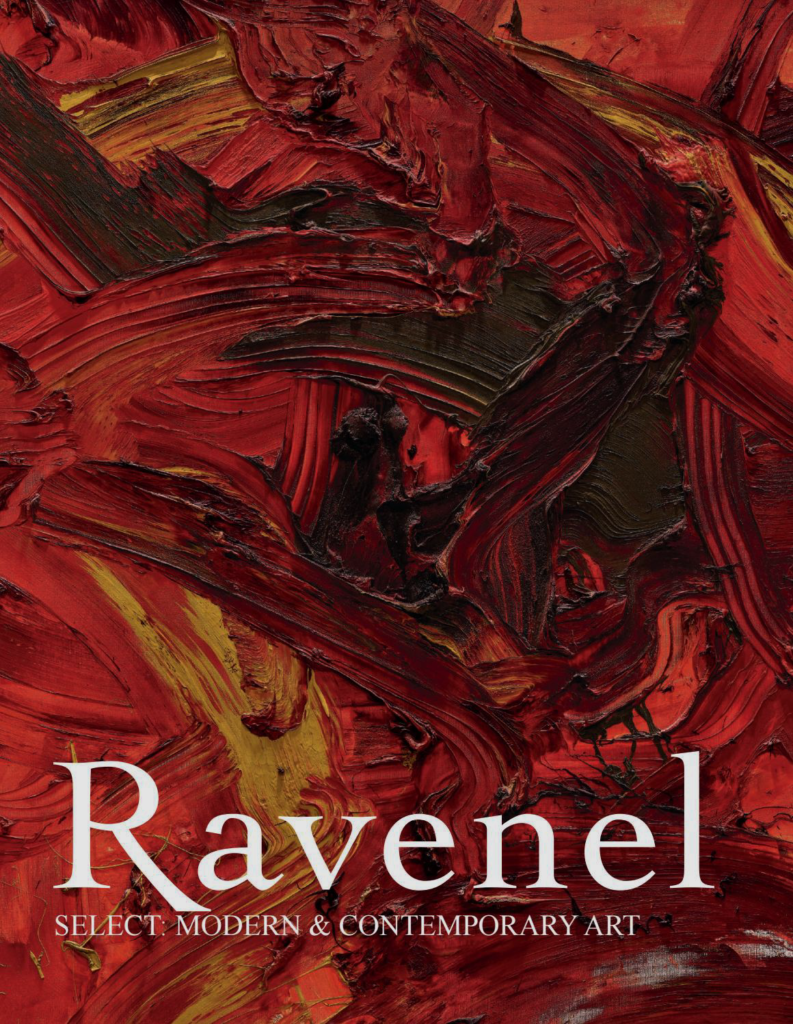
Alongside this trajectory, another presence emerges. Boi Tran. Her work, featured on the catalogue cover, does not seek to confront this history. It inhabits it. Élégantes in Hué, conceived as a triptych, unfolds within a structure that recalls the classical European format. Yet what it contains belongs elsewhere. A group of women, walking, seated, or in quiet movement, appear not as narrative figures, but as states of being. The garden in which they exist is not a place of spectacle. It is a space of suspension. Time does not advance. It settles. The composition, described as extraordinary within the catalogue, does not rely on complexity. It relies on balance. Each figure holds its position. Each gesture is measured. There is no fragmentation. Only continuity.
In this, one may perceive the lasting influence of her teacher, Nguyen Trung. Not as imitation, but as transmission, a shared attention to the female form, not as object, but as a locus of presence. Yet, where his work often tends toward stylisation and abstraction, Boi Tran’s remains anchored in stillness. Her figures do not assert themselves. They endure. The use of lacquer reinforces this condition. It is a medium that resists immediacy. Built through layers, polished over time, it absorbs gesture rather than displaying it. What appears is not surface, but depth. Within the broader narrative proposed by Ravenel, Boi Tran’s position becomes clear.
She does not stand as an exception.
She occupies a space that is both continuous and singular, one of the few Vietnamese female artists whose work has entered the international auction field, while maintaining a language that remains distinctly her own. In this sense, her presence within the sale reflects more than inclusion. It reflects a condition. A practice shaped over time, now visible within a wider field.
Not emerging abruptly. But already there.
Vietnamese modern art features a unique aesthetic sense due to the historical background of the country. Vietnamese culture differs from other Indian-influenced Southeast Asian countries like Cambodia, Laos and Thailand, and does not share many similarities with Malay countries, such as Indonesia and Malaysia. War with and colonization by the West definitely changed the history of all Southeast Asian and East Asian countries. The recent history of Vietnam is filled with blood, tears, and suffering.
Vietnam was called by its old name Jiaozhi and Annam before the name, “Vietnam”, was introduced in the 19th century. Ancient Vietnam had either been a territory or a vassal state of China. Due to close relations between the two countries since China’s Qin Dynasty, Vietnam and China shared a similar culture for thousands of years. In the mid-19th century, France invaded and colonized Vietnam. During World War II, it was also temporarily occupied by Japan.
However, Vietnamese communists successfully toppled the French colonial government in 1945. In the 1950s, conflicts between North Vietnam, backed by communist China, and South Vietnam, backed by the U.S., caused the outbreak of the Vietnam War. The war ended after the US military retreat from Vietnam in 1973, as the re-united states of Vietnam named their own country the Socialist Republic of Vietnam, formed in 1976. The economic revolution in 1986 eventually brought Vietnam to a new era.
Vietnamese modern art is very influenced by French culture due to centuries of French colonization. The colonial government founded the School of Fine Arts of Indochina (Ecole des beaux-arts de l’Indochine) in Hanoi in 1925. Western education was also implemented along with the introduction of classicalism and impressionism art. However, Vietnamese traditional art like silk painting and lacquer painting was retained and continued, which eventually evolved into a new style of modern art creation. Modern Vietnamese artists tend to emphasize the theme of individual freedom. However, the pristine custom causes a more implicit presentation. Located in a tropical area, Vietnam is an agriculture-based country. The fusion of tradition and western influences creates a harmonic and romantic art style for the Buddhist country.
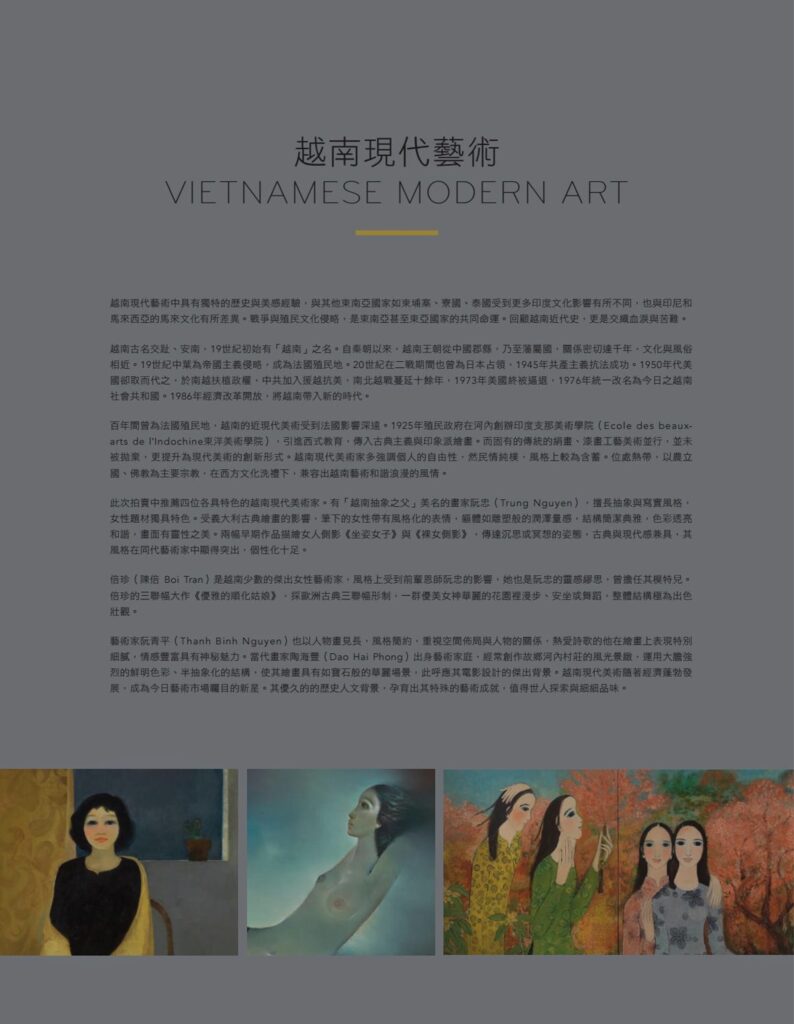
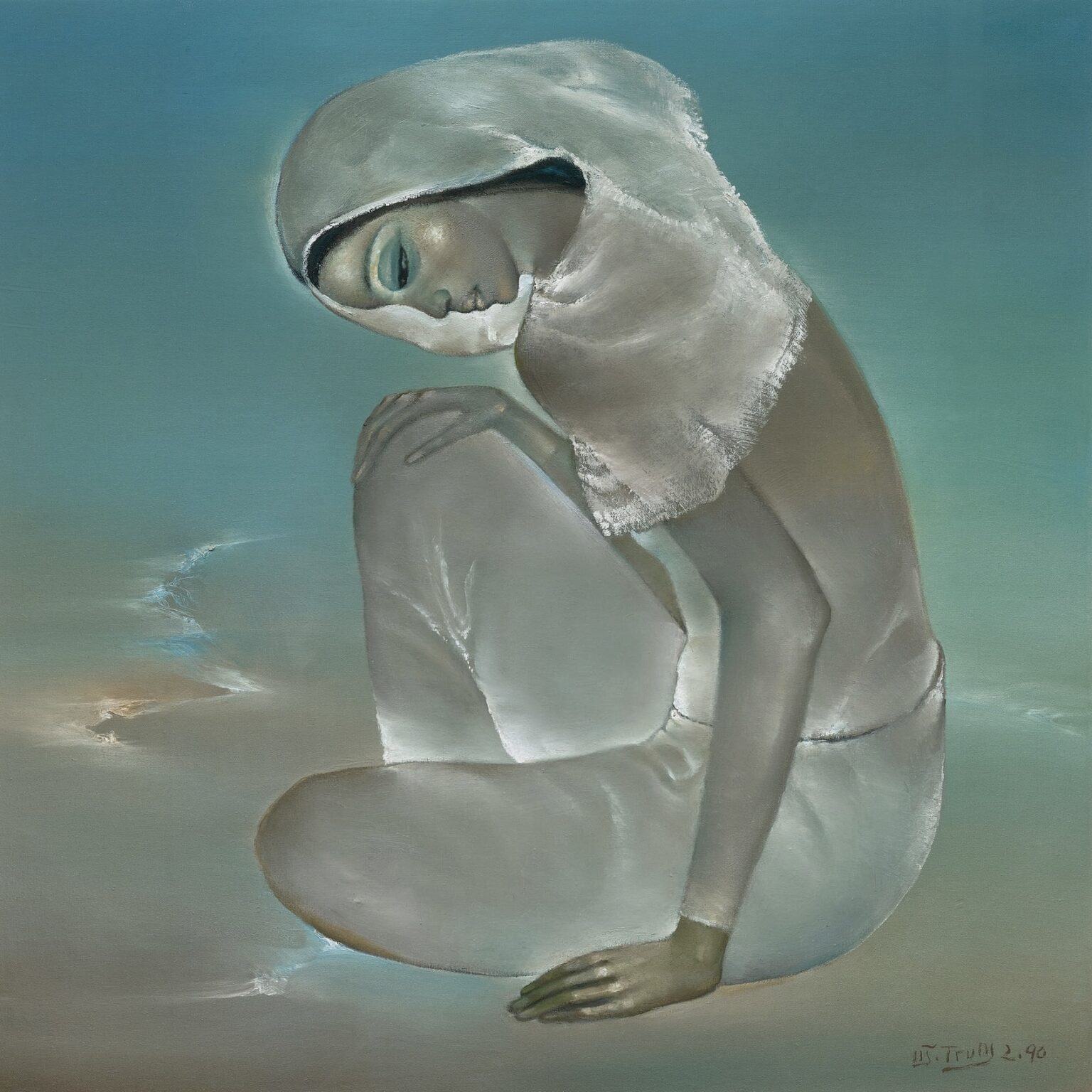
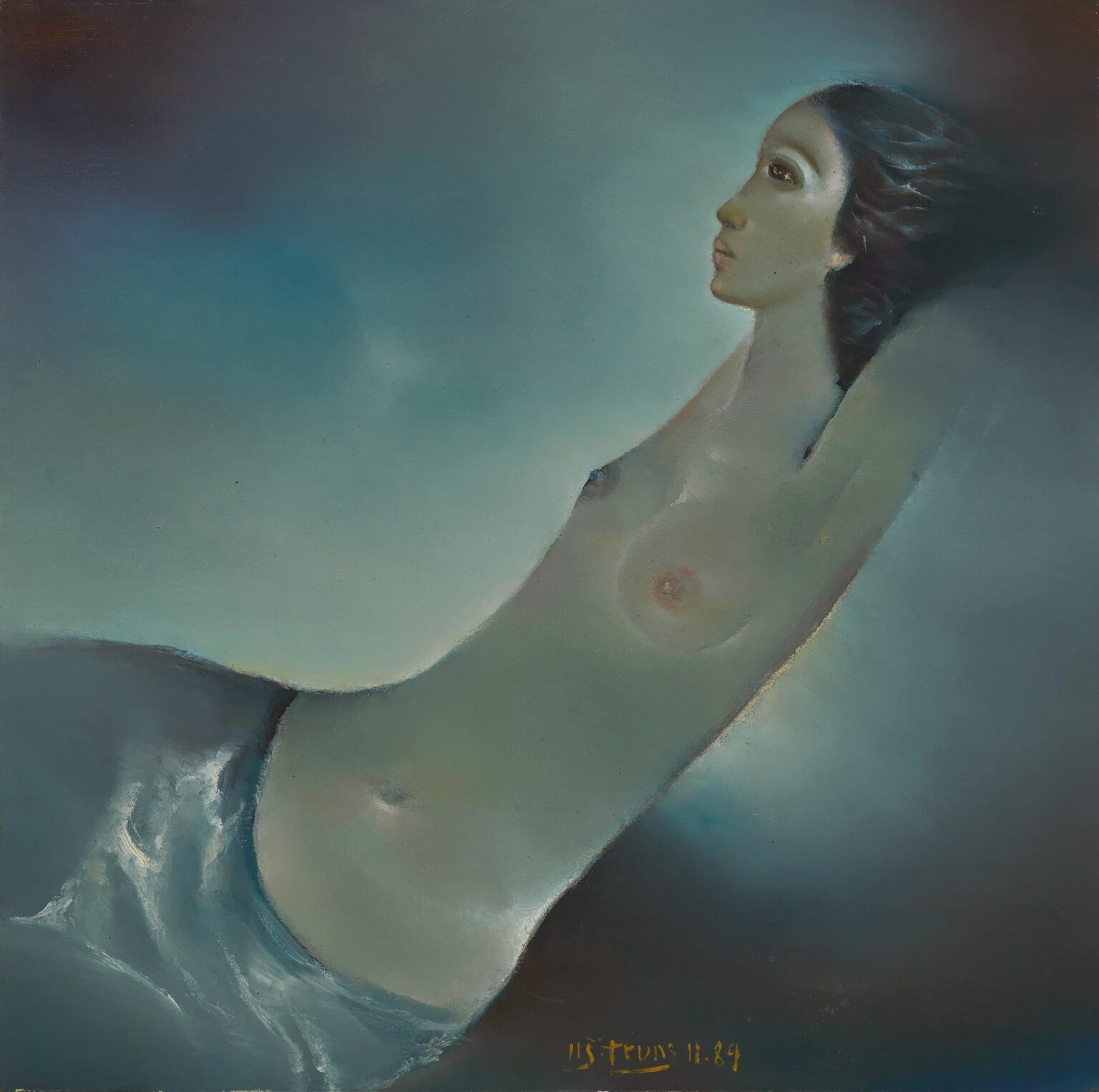
This auction introduces four distinctive Vietnamese artists. Trung Nguyen, known as “the father of Vietnamese abstract art”, is known for his abstract and realistic style in female-themed works. Influenced by Italian classic art, the expressions of the women he drew are stylized, and the bodies are just as smooth as Italian statues. Elegant compositions along with bright and harmonic colours show a spiritual beauty in the picture. Two of his earlier works, Seated Woman and Reclining Nude, present subjects in thinking and meditating posture, exhibiting a classic as well as contemporary style. His style stands as a breakthrough among other artists from the same era, which perfectly describes his unique personality.
Boi Tran is one of the few outstanding Vietnamese female artists. Her style is heavily influenced by her teacher, Trung Nguyen. She also worked as Nguyen’s model, serving as a source of creative inspiration for Nguyen. Tran’s Elegant in Hue trilogy is presented in a classical European triptych form. They depict a group of beautiful goddesses strolling, sitting and dancing in a glorious garden. The composition of the piece is extraordinary and spectacular.
Boi Tran was born in 1957. She learnt basic painting skills from Trung Nguyen, one of the greatest contemporary painters and lacquer artists of Vietnam. Tran is best known for her lacquer pieces. She makes use of triptych and tetraptych. Her artistic expression shows a great similarity with his teacher Trung Nguyen. Both the teacher and the student are skilful in capturing the beauty of women and representing characteristic Vietnamese sensibility and aesthetics. Tran often depicts graceful women wearing traditional Vietnamese dress áo dai. Some of them are gazing into the distance and the others looking down at the flowers, but all are calm and elegant. One of Tran’s solo exhibitions was held in 2004 at Minh Chau Art Gallery, Hanoi. In recent years, she has mainly exhibited at her own gallery opened in 1998 at Boi Tran Garden on Thien An Hill about 10 kilometres southwest of Hue.
Select: Modern & Contemporary Art
Ravenel Spring Auction 2019
Saturday, June 1, 2019, 2:00pm
Grand Space 3F, Taipei Marriott Hotel
No. 199, Lequn 2nd Rd., ZhongShan Dist., Taipei City, Taiwan