

An Offering of Silence: The Zen Inscription to Boi Tran
Venerable Sugata Thích Chơn Hương
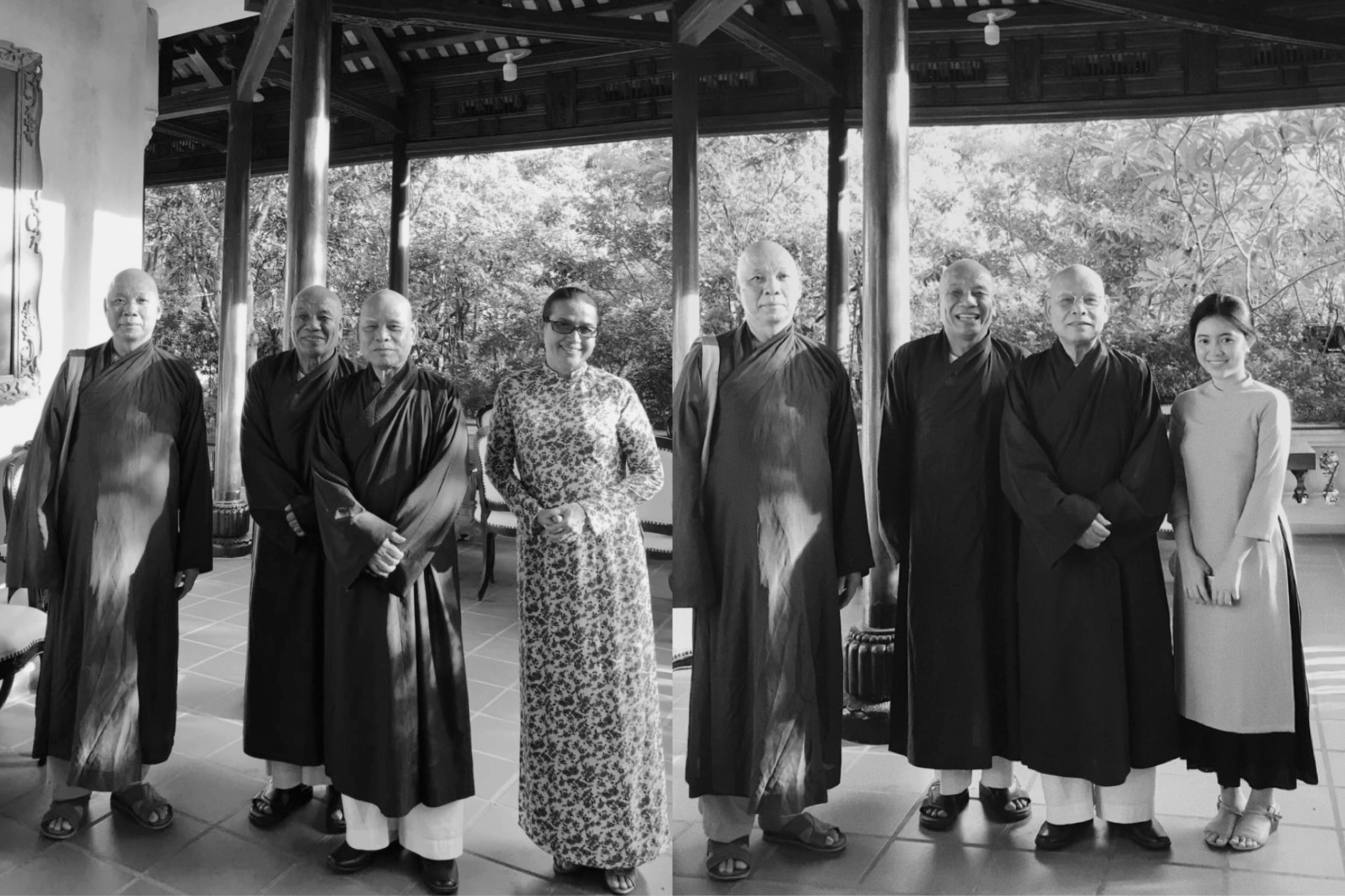
There are moments that do not announce themselves, and yet remain. One such moment unfolded quietly at Boi Tran Garden, where a small gathering of Buddhist masters paused within its stillness. Nothing had been arranged; nothing needed to be. In that shared quiet, a poem was offered, not as tribute, but as recognition, a reflection on how a life, shaped by time and experience, comes to rest in grace.
There are moments that do not seek to be remembered, and yet remain.
They do not announce themselves as events. They leave no formal trace of occasion. And still, they endure, not as spectacle, but as presence.
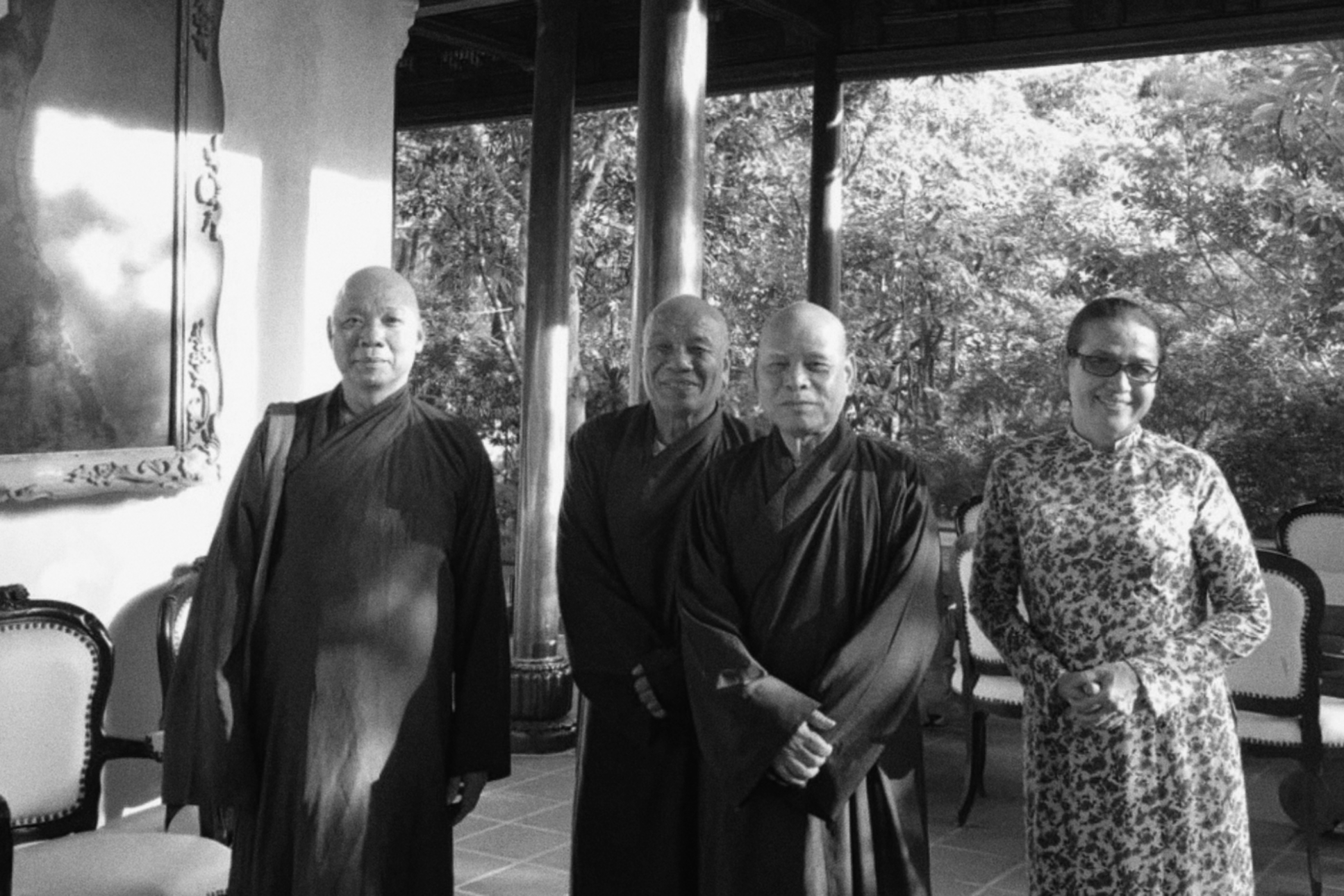
One such moment unfolded quietly at Bội Trân Garden, when a small group of Buddhist masters, paused within its stillness. Among them was the Most Venerable Sugata Thích Chơn Hương of Quảng Tế Temple, accompanied by Thích Trí Tựu of Linh Mụ Temple and Thích Thiện Phước of Châu Lâm Temple.
Nothing had been arranged. Nothing needed to be.
The Garden received them in the way it receives all who enter without urgency. Light filtered through wood and foliage. Conversation rose and dissolved without insistence. Silence was not an absence, but a shared condition.
What took place that day cannot be described as an event. It was closer to recognition.
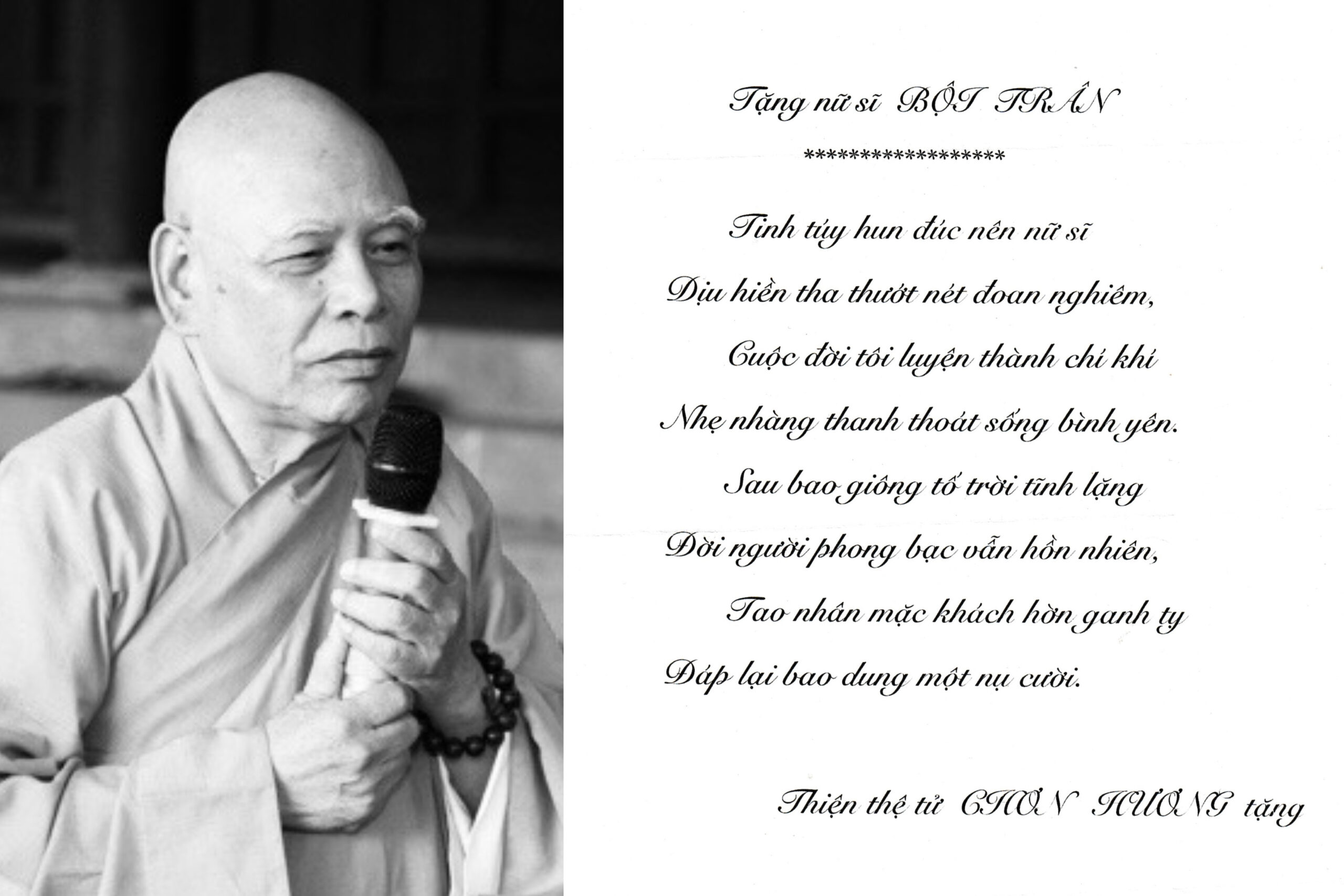
Within this atmosphere, a poem was offered by Thích Chơn Hương to the painter and intellectual Bội Trân. Titled simply To Woman Intellectual Boi Tran, the text carries neither ornament nor rhetoric. It reads with the clarity of something observed, rather than composed:
Quintessence refines the woman intellectual
She is tender, graceful, and virtuous
The vicissitudes of life cultivate her willpower
She is gentle, unworldly, and peaceable
At first glance, the poem appears to describe a person. Yet what it truly reveals is a process.
The opening line, “quintessence refines,” suggests not inheritance, but distillation. The woman described is not defined by status or role, but by what has been slowly formed within her. Refinement here is not decorative. It is the result of time, of pressure, of life lived attentively.
The following lines move with a quiet duality. Grace is paired with discipline. Gentleness with resilience. The poem does not separate these qualities, but allows them to coexist, as they often do in lived experience. What appears soft is not fragile. What appears calm has already endured.
The third line introduces the turning point: “The vicissitudes of life cultivate her willpower.” This is where the poem deepens. Adversity is not framed as interruption, but as formation. The language does not dramatise hardship. It absorbs it. Strength emerges not through resistance, but through transformation.
In its Vietnamese original, this sensibility becomes even more intimate:
Cuộc đời tôi luyện thành chí khí
Nhẹ nhàng thanh thoát sống bình yên.
Here, the idea of being “forged” by life carries both weight and release. What is formed does not harden. It becomes lighter. A certain inner freedom appears, not despite experience, but because of it.
The final lines introduce a more human register:
Distinguished writers, eminent poets begrudge and resent
Her reciprocation is altruistic, with a smile
This is perhaps the most revealing moment of the poem.
Recognition, the text suggests, is never neutral. To be seen is also to be measured, sometimes unfairly. The presence of envy is acknowledged without emphasis. It is treated as part of the human condition, not as a disruption of it.
What matters is the response.
There is no defence, no correction, no withdrawal. Only generosity, and a smile. Not as performance, but as disposition. It is a form of strength that does not seek to assert itself.
In this way, the poem becomes less a portrait than a reflection on conduct. It does not ask who Bội Trân is. It suggests how one might remain whole.
At Bội Trân, such a proposition is not abstract.
The space itself carries the same quiet logic. Architecture does not dominate. It yields to the landscape. Paintings do not compete for attention. They remain, allowing time to complete what the eye begins. Even hospitality unfolds without excess, guided by an understanding that refinement lies in restraint.
It is perhaps for this reason that the encounter between the Buddhist masters and the painter feels neither accidental nor symbolic. It feels aligned.
The poem remains today as a document. A sheet of paper, typewritten, unadorned.
And yet, what it carries exceeds its form.
It is not simply a text to be read, but a gesture to be held. A moment in which language, presence, and understanding came briefly into balance.