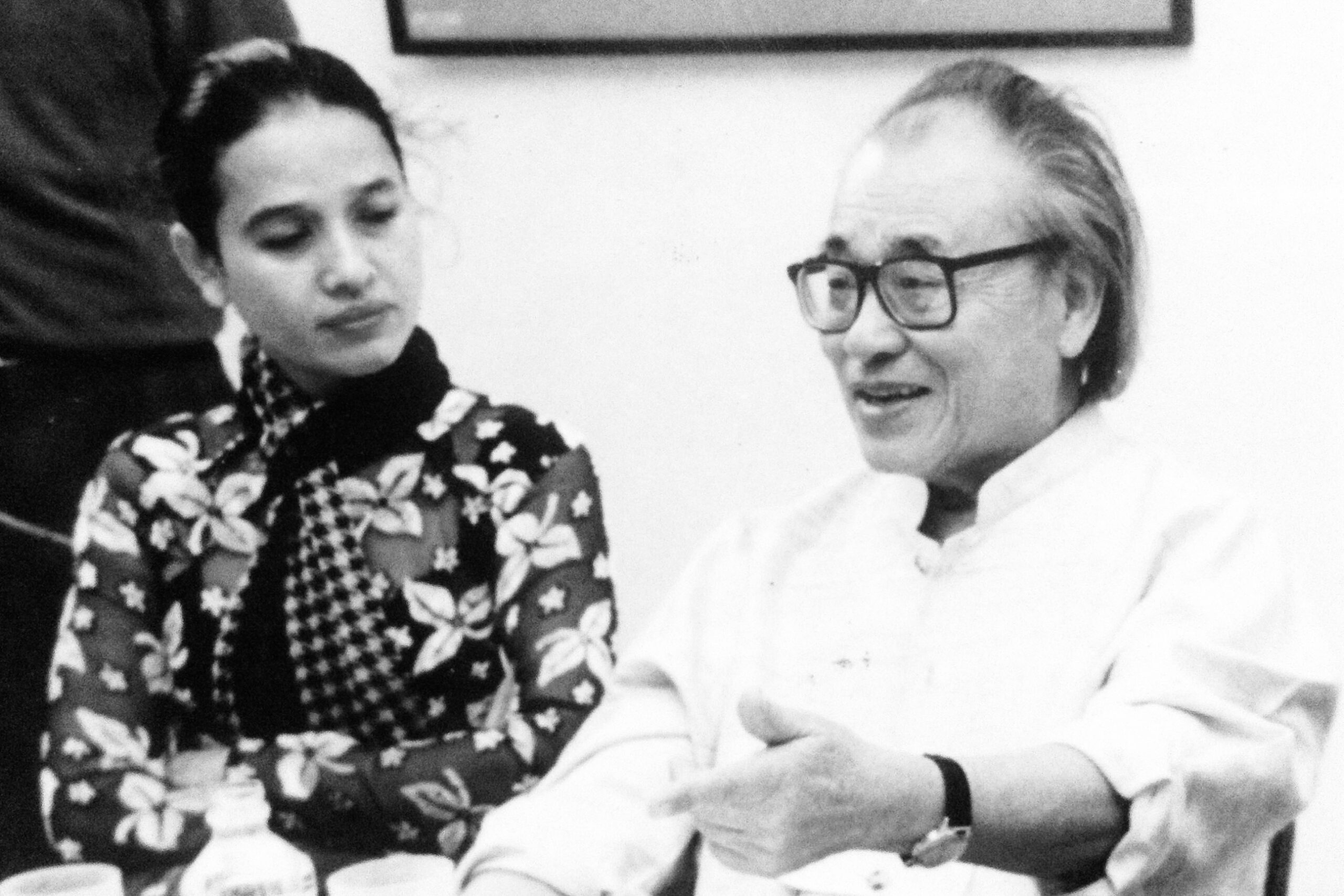
Le Ba Dang and Boi Tran: A Letter, A Promise, and the Quiet Measure of Trust
Long before these letters were written, the connection had already been established. It was Lê Bá Đảng who sought out Bội Trân, recognising in her not a function, but a presence. The letters from Paris do not begin a relationship; they return to one already known. What they reveal is not how a bond is formed, but how it endures, quietly, without declaration, sustained by a trust that requires neither explanation nor proof. In this way, Bội Trân emerges not as intermediary, but as something rarer, a point of return for artists, where continuity is held, and where trust remains unspoken, yet certain.
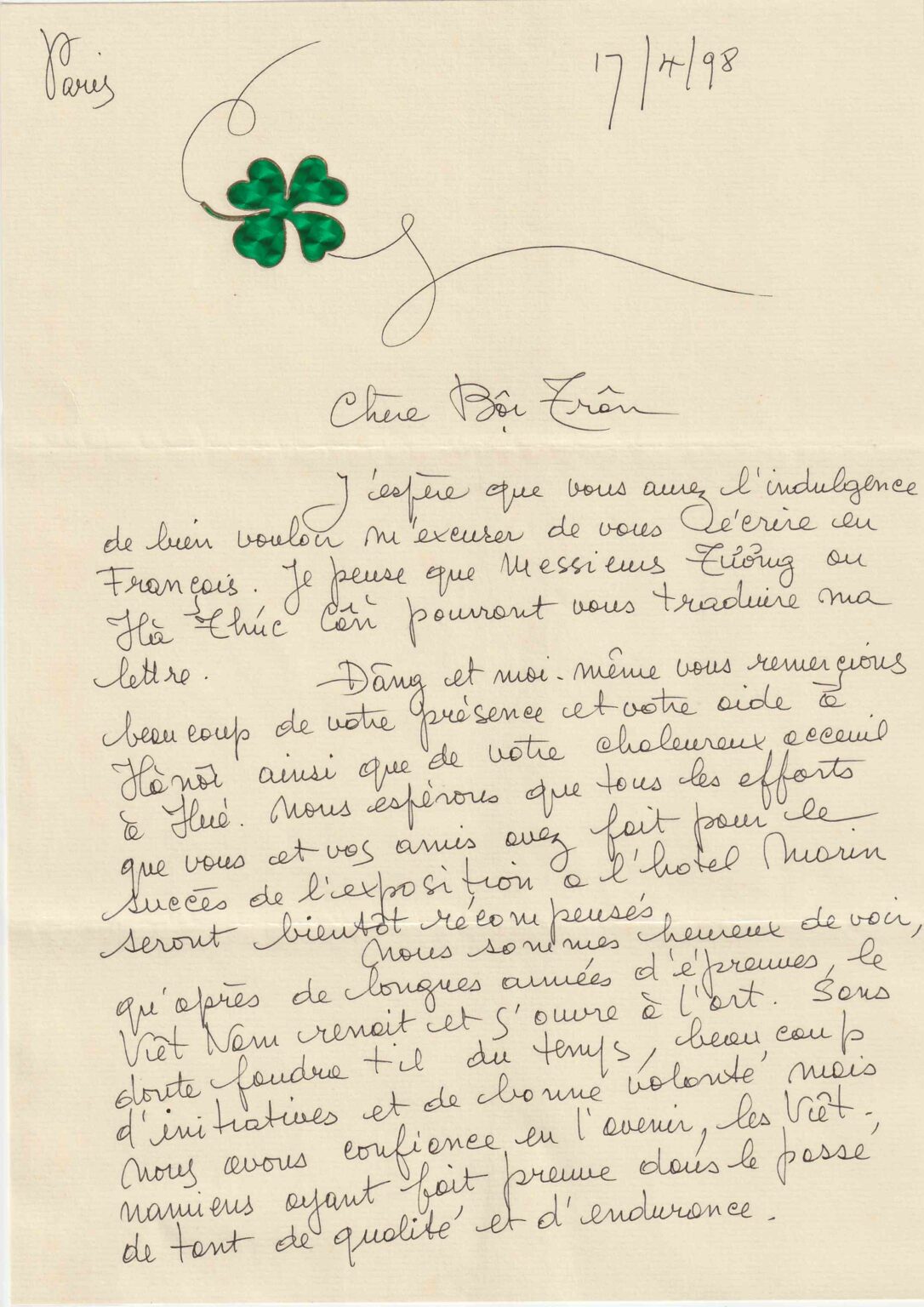
Paris, 17 April 1998.
A small envelope is prepared. Inside, a few photographs, moments already past, now held in paper. They are sent not as record, but as remembrance.
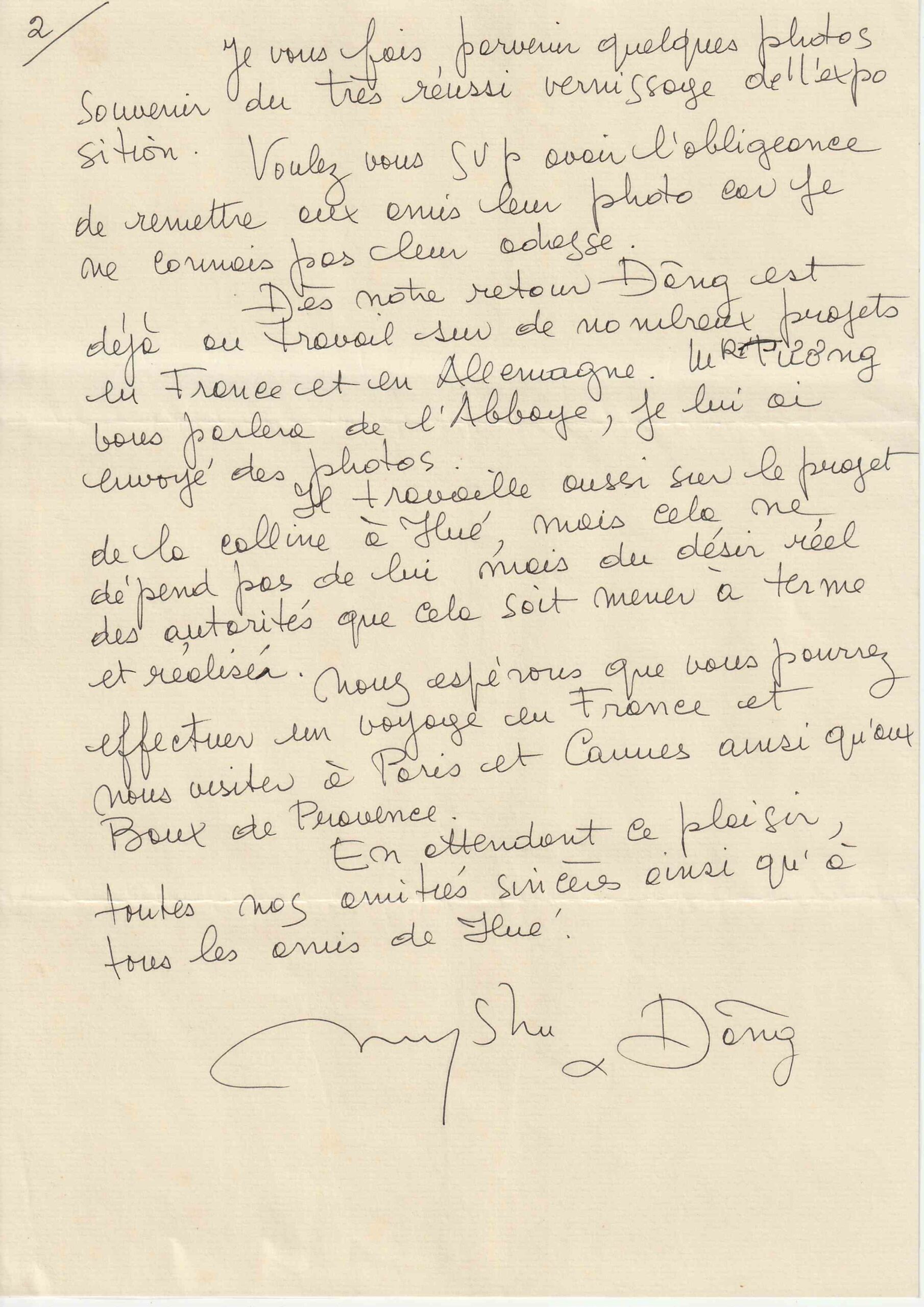
A few photographs – mementos
For Madame Bội Trân
With friendship
Myshu & Đảng
Paris, 17 April 1998
Dear Bội Trân,
I hope you will kindly excuse me for writing to you in French. I believe that Mr Tuong or Mr Hà Thúc Cần will be able to translate my letter for you.
Đãng and I thank you very much for your presence and your assistance in Hanoi, as well as for your warm welcome in Huế. We hope that all the efforts you and your friends have made for the success of the exhibition at the Morin Hotel will soon be rewarded.
We are happy to see that, after many years of hardship, Vietnam is being reborn and opening itself to art. No doubt it will take time, many initiatives, and much goodwill, but we have confidence in the future, as the Vietnamese have shown in the past so many qualities and such endurance.
I am sending you a few souvenir photographs from the very successful opening of the exhibition.
Would you please be so kind as to pass on their photographs to your friends, as I do not know their addresses.
Upon our return, Đãng is already at work on numerous projects in France and Germany. Mr Tuong will speak to you about the Abbaye; I have sent him some photographs.
He is also working on the project of the hill in Huế, but this does not depend on him, rather on the genuine will of the authorities for it to be carried through and realised.
We hope that you will be able to travel to France and visit us in Paris and Cannes, as well as in Les Baux-de-Provence.
While awaiting that pleasure, please accept our sincere friendship, as well as our greetings to all friends in Huế.
Myshu & Đảng
The gesture is modest, almost incidental. And yet, it carries a certain intention, to return something of what has been shared.
The letter that accompanies the photographs speaks in a tone that does not belong to formality. It recalls Hanoi, Huế, the exhibition at the Morin Hotel, and the efforts that made it possible, not as separate contributions, but as something held in common.
Gratitude appears here without emphasis. It does not elevate the occasion, nor does it isolate it. It recognises, instead, a continuity, a sense that what has taken place is part of something still unfolding.
The letter extends further. It speaks of Vietnam at a moment of reopening, of renewal after years of hardship. It does not anticipate quickly, nor does it idealise. It acknowledges time, effort, and goodwill as necessary conditions, and places its confidence not in certainty, but in endurance.
The photographs are sent back to Huế, not to preserve an event, but to return it to those who shaped it. The request that they be shared with others, whose addresses remain unknown, suggests something else, that the network formed there exceeds what can be contained or recorded.
Already, the exchange moves beyond documentation. It becomes relation.
One year later, another letter arrives.
Paris, early 1999.
A sheet of paper, handwritten, unguarded. No preamble, no framing, only a few lines sent across distance, as though the act of writing itself were already sufficient.
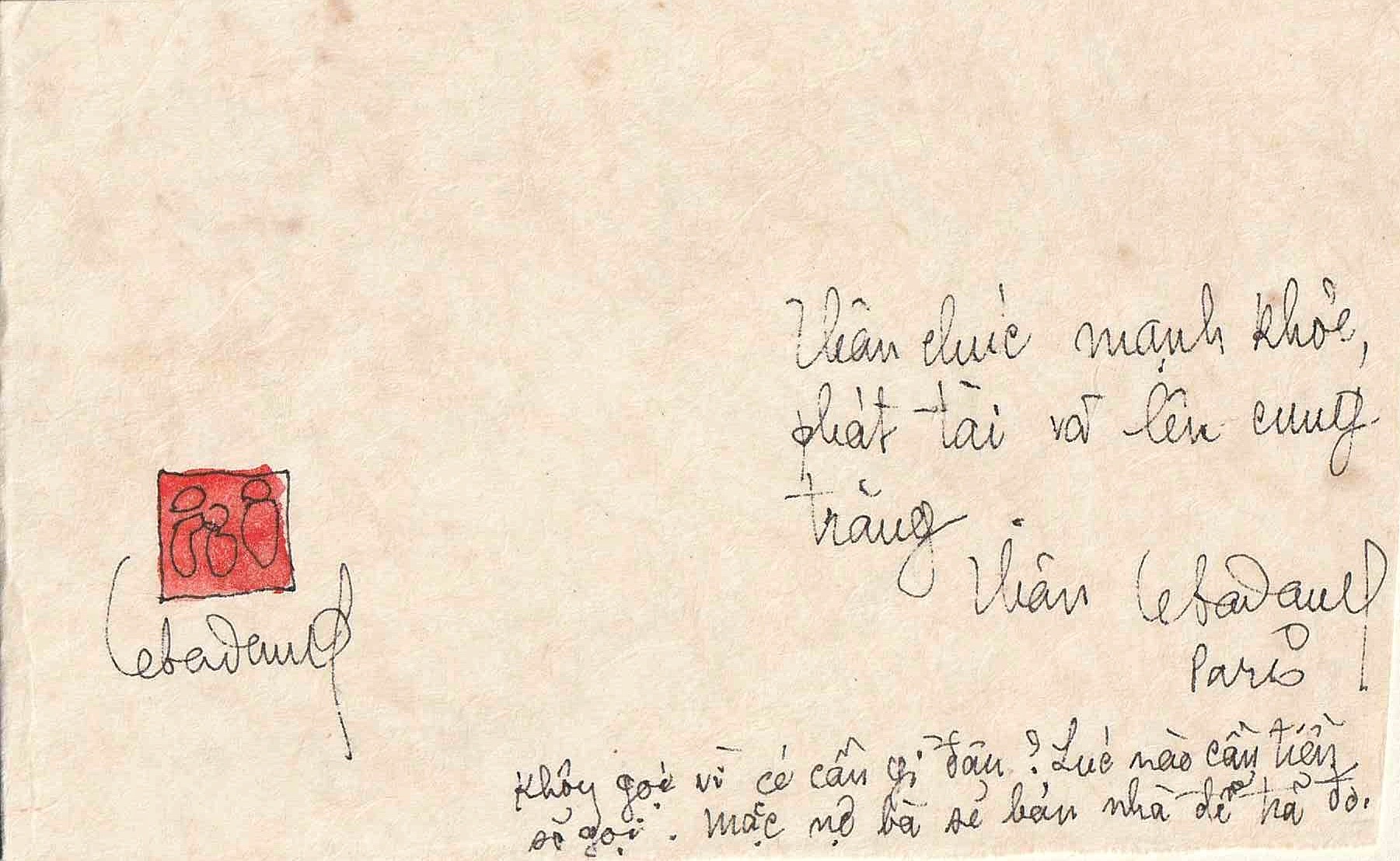
“Fondly wish you health, prosperity and ups to the moon…
Badly off, I’ll phone; I would sell my house to pay you back when in debt to you.”
The words arrive without emphasis. They do not attempt to persuade, nor to explain. They settle instead into a kind of quiet certainty, where meaning does not need to be constructed, only recognised.
It is not the kind of text one expects to find among documents shaped for record or memory. It remains closer to something immediate, almost instinctive, a gesture made without calculation, where what is said carries precisely the weight it intends, no more, no less.
By the late 1990s, Lê Bá Đảng had long been living and working in Europe, moving between Paris and a broader artistic milieu. His practice had unfolded across different contexts and traditions, and outwardly, it suggested a trajectory already in place.
And yet, what the letter reveals belongs to another register. Even within a life that appears formed, there remain moments that call for something more essential, not recognition, but assurance.
Within this brief note, another dimension appears, one that withdraws from scale entirely. It does not extend outward into visibility or movement, but turns inward, toward a quieter point of reference.
Here, what is revealed is not the artist as seen, but the individual in relation.The letter does not describe a situation. It does not narrate a need. It simply holds, within a few unadorned lines, the presence of another person. A point of return.
Between the photographs sent in 1998 and the handwritten note of 1999, something becomes perceptible. Not a sequence, not a narrative, but a continuity. A correspondence that does not accumulate information, but sustains connection.
Paris and Vietnam remain distant. The distance is neither denied nor resolved. It is held, instead, within the assurance that somewhere, someone remains, not as function, but as presence.
It is within this space that Bội Trân’s role becomes visible. Not as intermediary, nor as patron in any formal sense, but as something quieter, and perhaps more enduring. A point of continuity. A figure of assurance.
A place to which one writes without explanation.
A place to which one returns without condition.
At Boi Tran Art Gallery, such relationships were never declared, and never displayed. Yet they formed part of its unseen structure, the quiet framework within which artists came, not only to exhibit, but to remain connected.
It was a space where work could exist alongside uncertainty, where presence was not conditional upon certainty or success. A place where one did not need to perform, only to arrive.
The gallery, from its earliest years, did not operate through assertion. It did not seek to position itself within a market, nor to define a movement. It functioned instead through a different economy, one shaped by attention, by continuity, and by a generosity that did not announce itself.
Over time, this ethos extended beyond the walls of the gallery into what is now Boi Tran Garden. The transition was not one of expansion, but of deepening. The same sensibility persists, not as principle, but as condition.
Here, art is not separated from life, nor protected from it. What is created, what is shared, and what is remembered all belong to the same continuum. Architecture does not contain experience, it allows it. The garden does not frame art, it receives it.
The letters remain today not as artefacts of correspondence, but as traces of this continuum.
Not as evidence of exchange, but as the quiet shape of trust.