

The Rebirth of Ancient Houses: Architecture, Memory and the Return to Hue Or Boi Tran and a Return to Living Heritage
HO SI BINH
Across Vietnam, the revival of wooden houses emerges quietly, shaped by patience, care, and a deep affection for what endures. In Hue, and at Boi Tran Garden, this return becomes something more intimate, where architecture is no longer an object, but a living presence, holding memory, stillness, and a way of being that feels both distant and familiar.
In recent years, something quiet has been taking place across Vietnam. Not a movement that announces itself loudly, but one that grows almost instinctively, a turning back toward what has long been part of life. The restoration of traditional wooden houses, particularly the nhà rường of Hue, speaks not only of architecture, but of a deeper need to return.
More and more people have begun searching for old, weathered wooden houses, some nearly abandoned, some already falling apart. They take them apart piece by piece, move them, and slowly bring them back to life. It is a process that asks for patience, for care, and above all, for affection. Because what is being restored is not only a structure, but a way of feeling at home.
There is perhaps, too, a quiet fatigue behind this return. Modern urban life, with all its convenience, has also become dense, enclosed, and at times overwhelming. Houses stand close together, space feels compressed, and the rhythm of living becomes hurried. In contrast, these wooden houses offer something different: space to breathe, light that moves, and a sense of calm that cannot be manufactured.
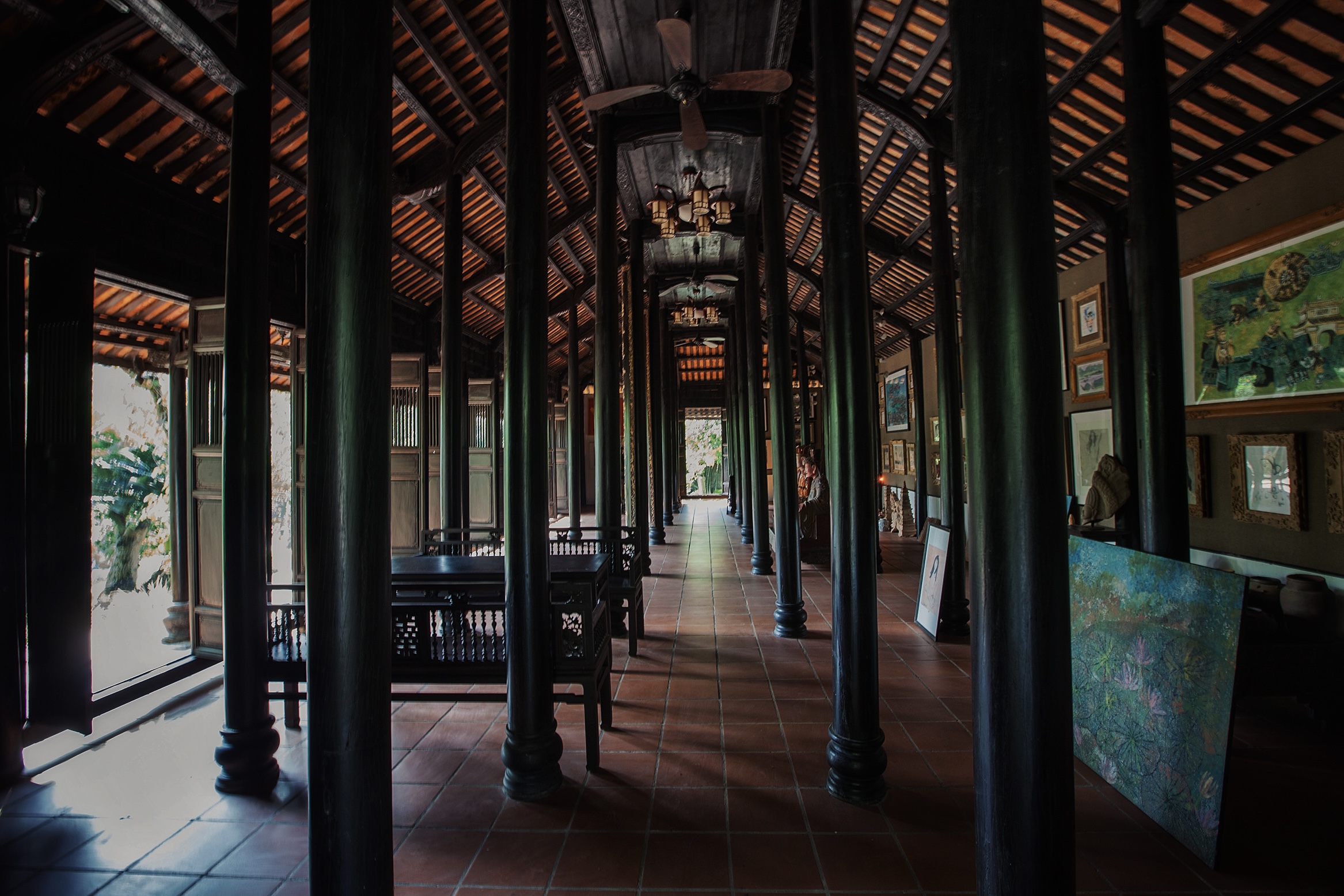
To step into a traditional house is to feel that difference immediately. The proportions are gentle, the air circulates, and the materials hold warmth. It is not simply about looking back, but about rediscovering a way of living where architecture does not dominate, but accompanies.
For many, restoring a nhà rường is not an easy undertaking. It requires land, time, and the willingness to search for fragments scattered across different regions. Old beams, columns, and carved elements must be found, gathered, and carefully reassembled. Skilled craftsmen are essential, but so too is a certain devotion. Without it, the process cannot truly begin.
In Hue, a few individuals have quietly devoted themselves to this path. Among them, Duong Dinh Vinh, Boi Tran, and Thang have spent years working with traditional wooden houses. Each follows their own way, yet what connects them is a shared sensitivity, a respect for the spirit of these structures, and for what they hold beyond their physical form.
At Boi Tran Garden, on the gentle slopes of Thien An Hill, this sensitivity becomes tangible. The space does not feel constructed in the usual sense. Instead, it unfolds slowly. A traditional Hue wooden house stands beside a Muong stilt house. Paths curve through the garden, paved with Bat Trang ceramic bricks, leading under tall, quiet pine trees.
Nothing feels forced. The elements seem to belong to one another, as though they have always been there. What is created is not simply a restored house, but an atmosphere, one that allows visitors to pause, to listen, and perhaps to remember something they had not realised they had lost.
Elsewhere in Hue, Ngự Hà Garden by Duong Dinh Vinh offers another experience. A series of wooden houses connected by a long veranda, opening onto a pond filled with lotus, creates a space that feels both open and sheltered at once.
There is something deeply human in these places. The carved wooden furniture, bamboo curtains, water jars, and shaded corners do not simply decorate a space. They hold traces of everyday life, gestures, habits, and time itself.
Yet, Hue today is changing. Buildings rise higher, particularly along the Perfume River, and with them, a different sense of space begins to take shape. The balance that once defined Hue, the quiet harmony between architecture and nature, becomes more fragile.
Perhaps this is why the return to wooden houses feels necessary. Not as nostalgia, but as a way of holding on to something essential. A way of keeping a connection alive, not only to the past, but to a certain way of being.
In this sense, the rebirth of these houses is not only about preservation. It is about care. About choosing, quietly, to remember.