A Prologue by Buu Y: Boi Tran Art Gallery and the First Form of Art in Hue
Buu Y
Once no art exhibitions have been organized with their actual sense; there would not have been any complete, conventional conformality to the land and her history.
Hue has long been recognised as a place of refinement, of memory, and of inward measure. Its artistic life, however, did not always possess a space commensurate with its depth. The absence was not visible, yet it was felt, by artists, by visitors, and by the city itself.
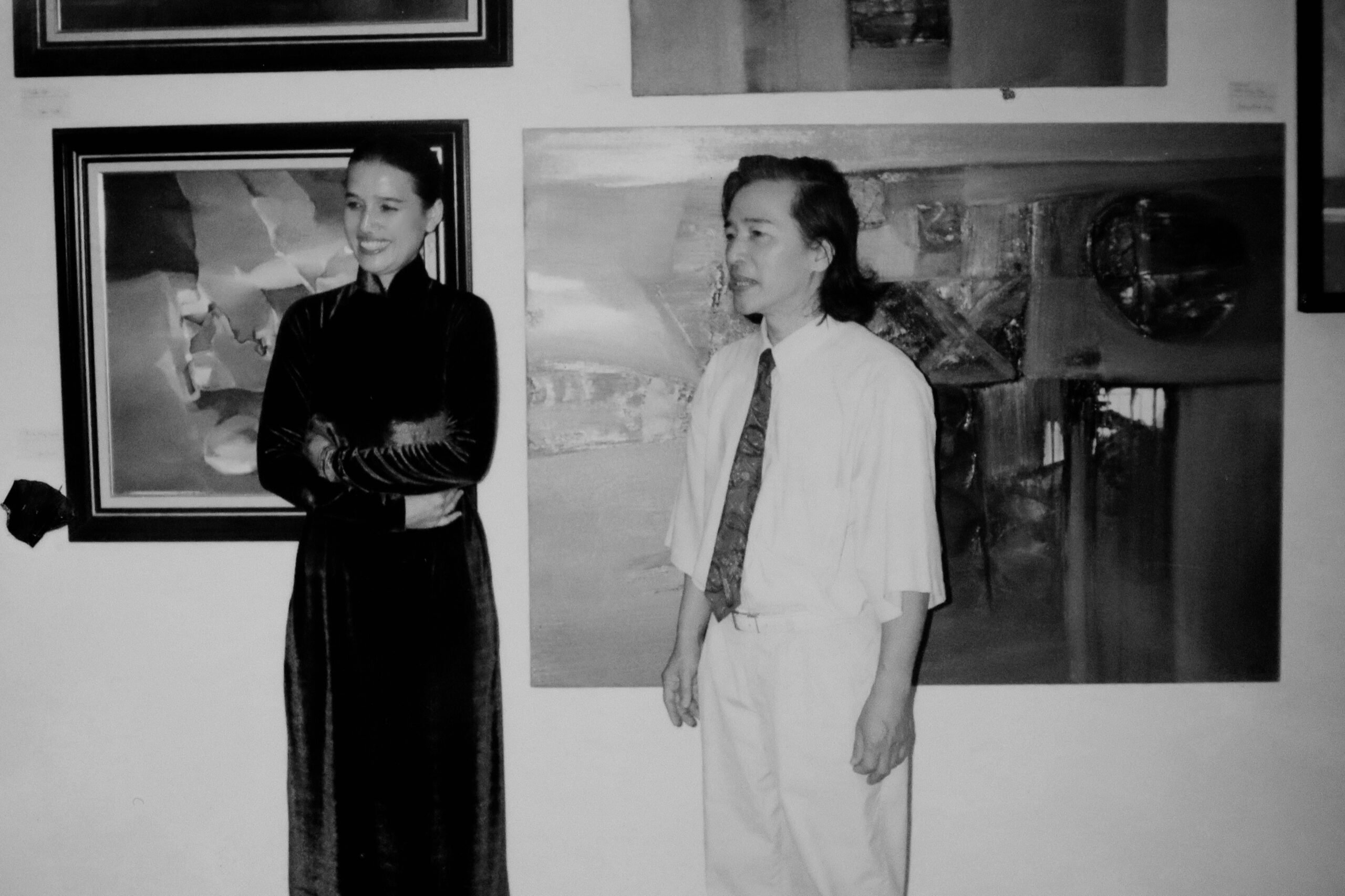
In 1995, with the opening of Boi Tran Art Gallery at the Saigon Morin Hotel, that condition began to find its form. The moment did not assert itself as an event, nor did it seek to define a direction. It responded, instead, to something already present, yet unarticulated.
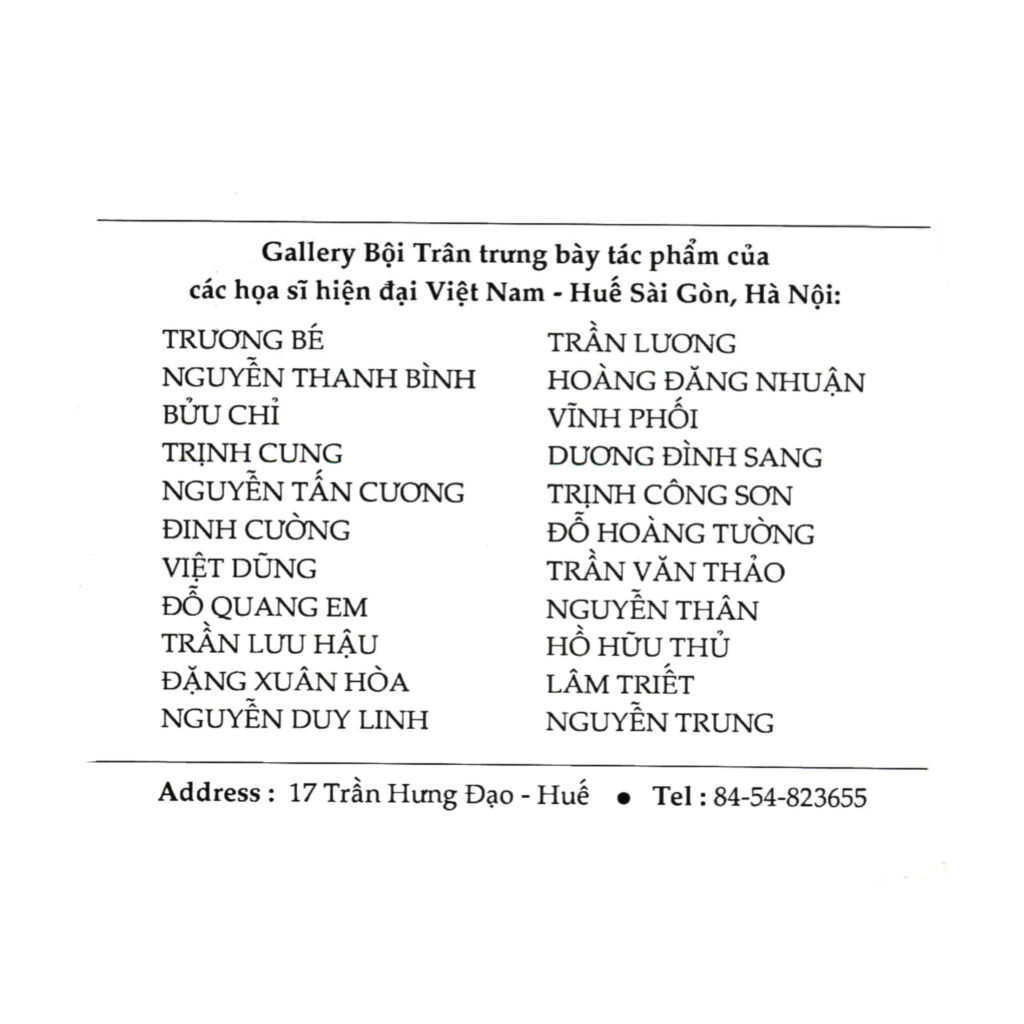
The inaugural exhibition gathered a generation of Vietnamese artists whose practices had shaped the country’s modern artistic language, Nguyen Trung, Hoang Dang Nhuan, Trinh Cong Son, Tran Van Thao, Do Hoang Tuong, Nguyen Tan Cuong, Hong Viet Dung, Do Quang Em, Dang Xuan Hoa, Ho Huu Thu, Truong Be, Vinh Phoi, Buu Chi, Dinh Cuong, Tran Luu Hau. Their presence marked not a culmination, but a recognition.
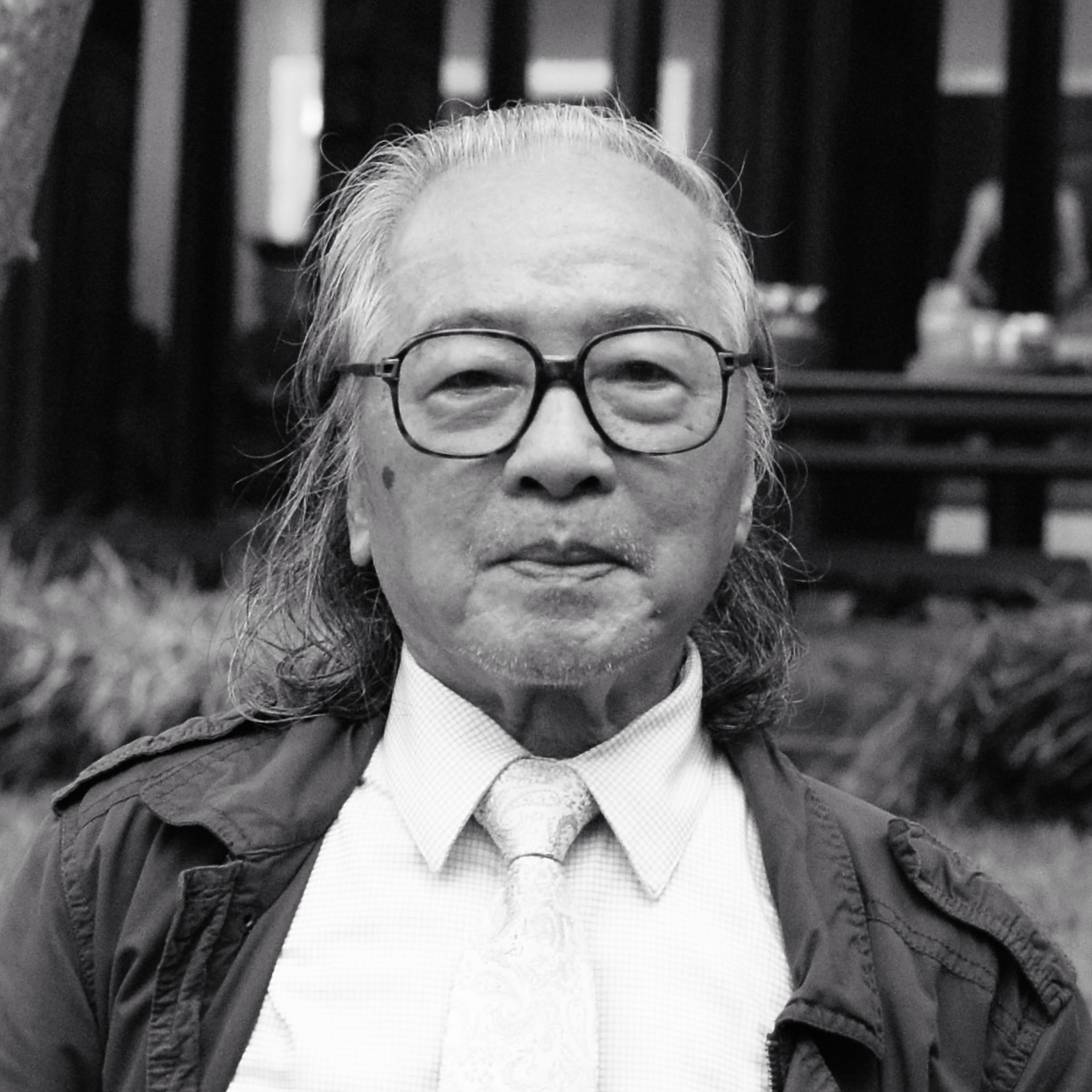
It was Professor Buu Y who gave this recognition its most enduring expression. Writing the prologue for the exhibition, he approached the gallery not as a structure, but as a necessity. His text remains one of the most precise reflections on the role of such a space, and is presented here in full:
Prologue
If there had not been any art exhibition, the artists would have missed something in connection with and on their own path, of which and what they have not been assured of themselves. Then, other clients and fans of art, who have come from parts of the world, would find somewhere for admiration and satisfaction; also the art partners would want to get in and into the colourful wings, from far away or back to this mossy green of recollection.
At different times, several art galleries have been born but not actually fulfilled and expected en masse.
How ungrateful is it?
Art painting exhibition is not as luxurious as what has been thought of by others. Typically it is a cultural approach, a model of flowery land, of the artful whispering in the future. Should it not have been a location for spiritual cultural rendez-vous for all ages, it would at least be a place for the ones who come to see it with silent, admiring contemplation.
How isn't it grateful?
Representing the land of cultural, art tradition and tourism and various schools, Hue has given birth to numerous talents with her famous mountain and river, and said to itself "stand up", and gotten confidence from everybody.
Once no art exhibitions have been organized with their actual sense, there would not have been any complete, conventional conformality to the land and her history.
Buu Y
What Buu Y articulated was not the emergence of a gallery, but the articulation of a condition. A city, in order to be complete, must recognise itself through form. Without such a space, something remains suspended, not absent, but unresolved.
The gesture of Boi Tran, in establishing the gallery, did not seek to resolve this condition by assertion. It aligned with it. The gallery did not impose meaning upon Hue; it allowed Hue to become legible to itself.
Over time, this initial space extended into what is now Boi Tran Garden. The transformation is not one of expansion, but of continuity. The same principles remain. Architecture yields to landscape. Objects do not compete. Nothing is arranged for effect.
Here, art is not elevated, nor diminished. It is allowed to remain. The visitor is not guided, but received. Time is not compressed, but permitted to unfold.
In this way, Boi Tran Garden continues the prologue written by Buu Y, not as text, but as condition. A place where what was once awaited has, quietly, taken form.