'I and The Call from Within' Exhibition: Nguyen Trung on Boi Tran’s World of Grace and Art
Nguyen Trung

Boi Tran, with a sensible heart and the gifted talent of an artist, fully perceives the artistic and literary beauty of nature that comes right out from her magnificent garden and then conveys that beauty most aesthetically to her works.
Nguyen Trung commented on Boi Tran's paintings as follows:
"Among different themes and subjects that Boi Tran expresses her art view, there are two themes that she finds herself connected to the most: Child-Motherhood and love for the nature.
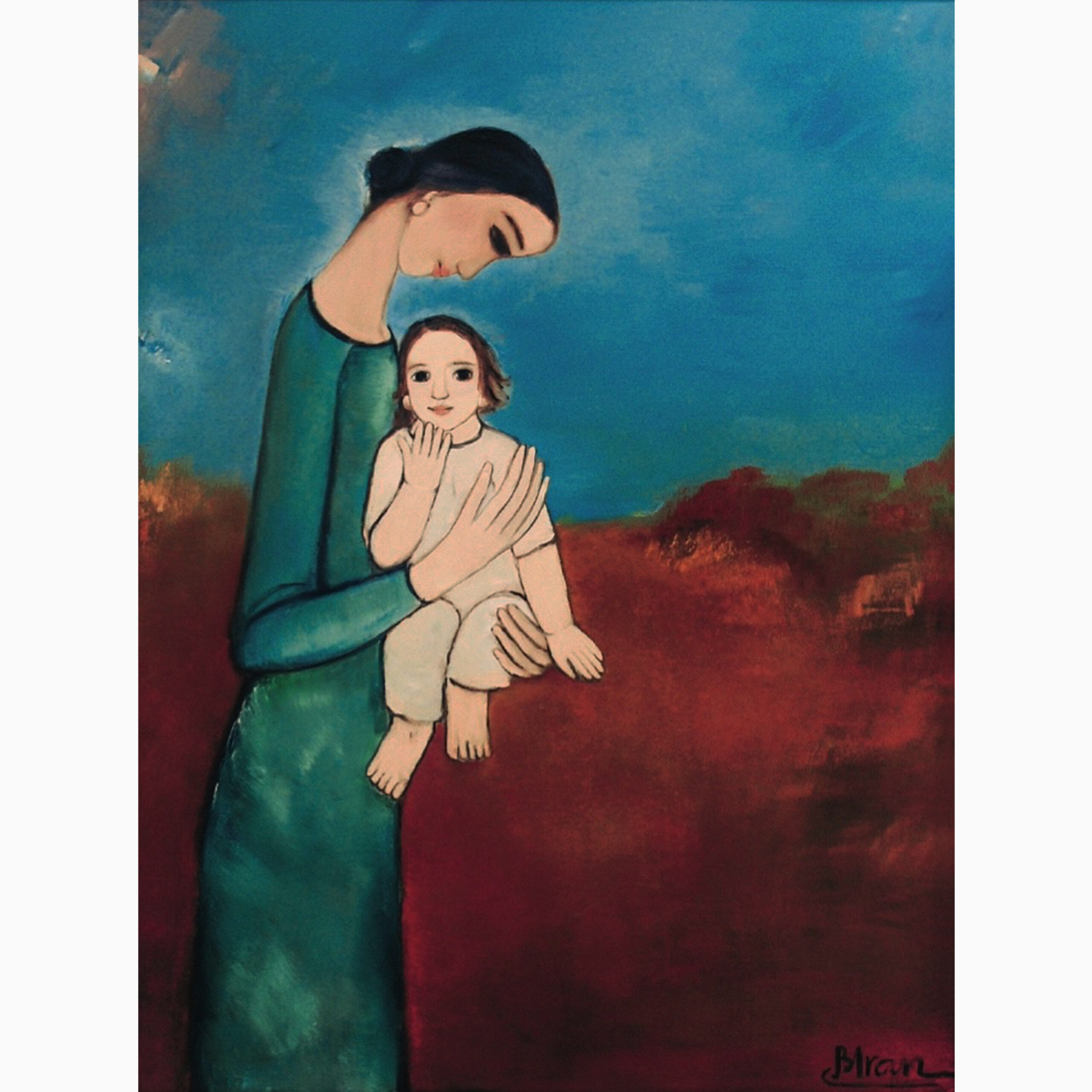
The Child-Motherhood, as always, is the most sacred sentiment compared to any other human relations because it is so intense and so profound. Deeply rooted in the personal experience of the loss of her dearest son not too long ago, the Child-Motherhood that is painted in Boi Tran's paintings clearly depicts the sorrow of a lost love. In many of Boi Tran’s paintings, one could easily find images such as a mother dearly holding a child in her arms, or a woman standing by the ocean desperately waiting for signs of her son to come home. In the other pieces are the images of a woman looking up to the sky with her hands drawn together as if she is praying for the day of reunion with her child. Completely carried away in her world where sadness, solitude, and reminiscences of the old happy-together days reign. However, her facial expression, in fact, her eyes are so radiant with love and faith! Perhaps, when people are taken to the lowest point of desperation, they'll learn to realize the beauty from within desperation itself that it helps complimenting the other extreme of human emotions.
As mentioned above, nature is another main source of inspiration to artist Boi Tran's works. Currently residing in Thien An Hills - one of the most beautiful landmarks of Hue city where it is known for endless rows of evergreen trees - Boi Tran, with a sensible heart and gifted talent of an artist, is able to fully perceive the beauty of nature that comes right out from her magnificent garden, and then convey that beauty in the most artistic fashion to her paintings. Lotus and hoa Quynh (a white orchid that only blossoms when the night falls and fades away when the sun rises) are her two favorite flowers and thus are often present in her works of art. Perhaps in these flowers she perceives the two most fundamental principles of life: the highest purity and the uncertainty.”
There are artists who seek the world, and there are those who return from it.
In reflecting on the work of Bội Trân, the painter Nguyễn Trung, a leading figure of Vietnamese modern art and co-founder of the Young Artists Association in Ho Chi Minh City, perceives not a practice shaped by outward ambition, but one guided by an inner call. It is a call that does not announce itself, yet persists, quietly, through time.
At the centre of Bội Trân’s work lies a sensibility both perceptive and deeply felt.
Nguyễn Trung observes in her a rare ability to receive the world not merely as image, but as presence. Nature, in her hands, is not described. It is understood. The garden in which she lives and works is not separate from her paintings, but continuous with them, a source from which visual and poetic impressions emerge and return.
Her paintings do not begin with composition. They begin with gratitude.
As the artist herself reflects, what she seeks to express is a form of thankfulness toward what life has offered, in its quiet generosity. This gratitude does not attach itself to grand narratives. It resides in moments that might otherwise pass unnoticed. A prayer addressed to the sacred Mother. The enduring bond between mother and child. The first light of morning, or the fragile trace of dew before it disappears.
These are not subjects. They are recognitions.
Among the themes that traverse her work, the feminine presence remains constant. Not as an ideal constructed for admiration, but as a lived condition. Her women do not perform. They remain. Their stillness is shaped by experience, by memory, by a quiet endurance that does not seek to explain itself.
Maternity, in this context, assumes a particular depth.
For Nguyễn Trung, it stands as the most intense and profound of human bonds. In Bội Trân’s work, this bond is inseparable from loss. The passing of her beloved son is not narrated, yet it is everywhere felt, forming an undercurrent that shapes the emotional structure of her paintings.
One encounters recurring images. A mother holding a child close within her arms. A solitary figure standing before the sea, suspended between hope and absence. A woman with hands gently joined, her gaze lifted upward, as though in prayer for a return that may never come.
These are not scenes of drama. They are states of being.
The atmosphere that surrounds them is one of quiet immersion. Sadness, solitude, and remembrance do not overwhelm the composition. They settle into it, with a certain inevitability. And yet, within this gravity, something luminous persists.
The eyes.
In many of her figures, the eyes remain radiant with love and faith. They do not deny sorrow. They contain it, and at the same time, transcend it. There is in this gaze a form of resilience that does not assert itself, but endures.
It is perhaps here that Bội Trân’s work reveals its quiet paradox.
At the threshold of despair, the paintings do not close. They open. They suggest that within the depth of human suffering lies also a capacity for perception. That beauty is not separate from sorrow, but may arise from within it.
Alongside this inward world, nature appears with equal clarity.
Living on Thiên An Hill, surrounded by the continuity of trees and shifting light, Bội Trân draws from a landscape that is both immediate and contemplative. Nguyễn Trung notes her ability to perceive not only its visible beauty, but its literary and emotional resonance, and to convey this with a rare sensitivity in her work.
Among the forms that return most often are the lotus and the hoa quỳnh.
The lotus rises from still water, untouched, a long-standing symbol of purity. The hoa quỳnh blooms only at night, and fades with the first light of dawn. One endures. The other disappears. Together, they suggest two conditions that define existence itself.
Purity, and impermanence.
In Bội Trân’s paintings, these are not symbols to be explained, but presences to be felt. They appear without emphasis, yet remain essential to the inner rhythm of the work.
If there is a thread that unites these elements, it is a quiet acceptance.
Her paintings do not seek to resolve experience. They receive it. They do not claim meaning. They allow it to emerge.
In this, Bội Trân’s work remains singular.
It does not ask to be understood immediately. It asks only to be encountered, as one might encounter a moment of stillness, a fleeting light, or a memory that returns without reason.
An inner call, heard not in words, but in presence.