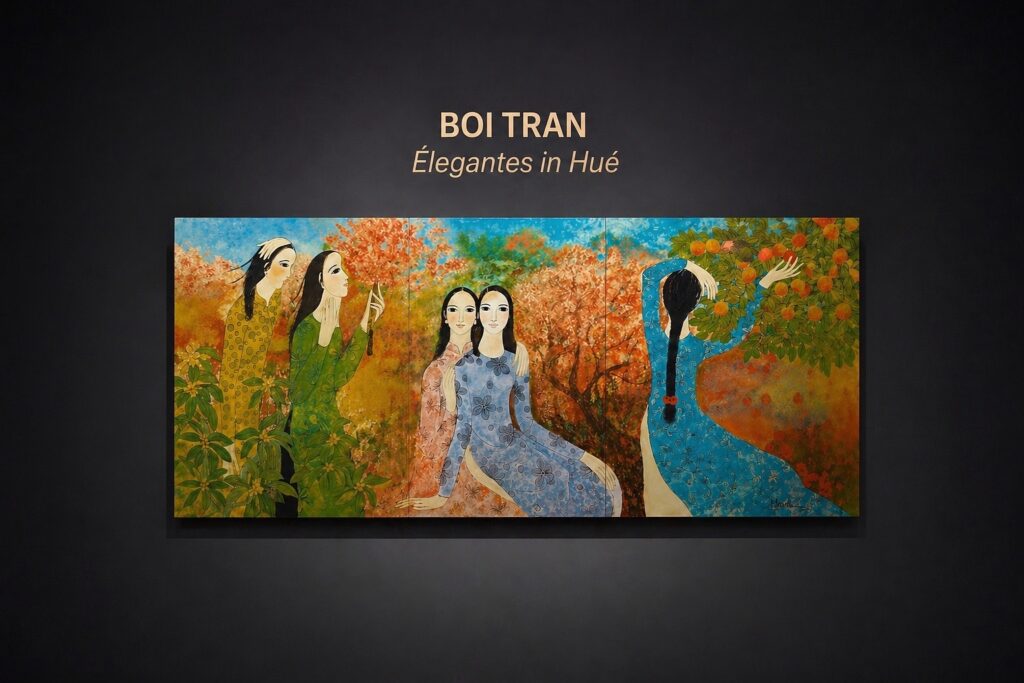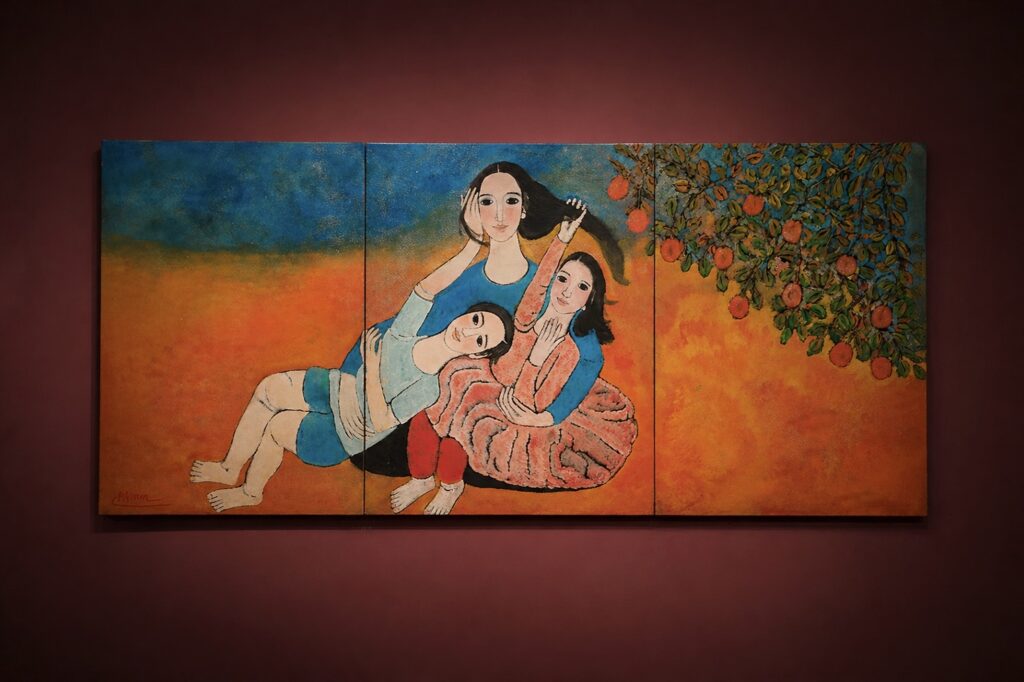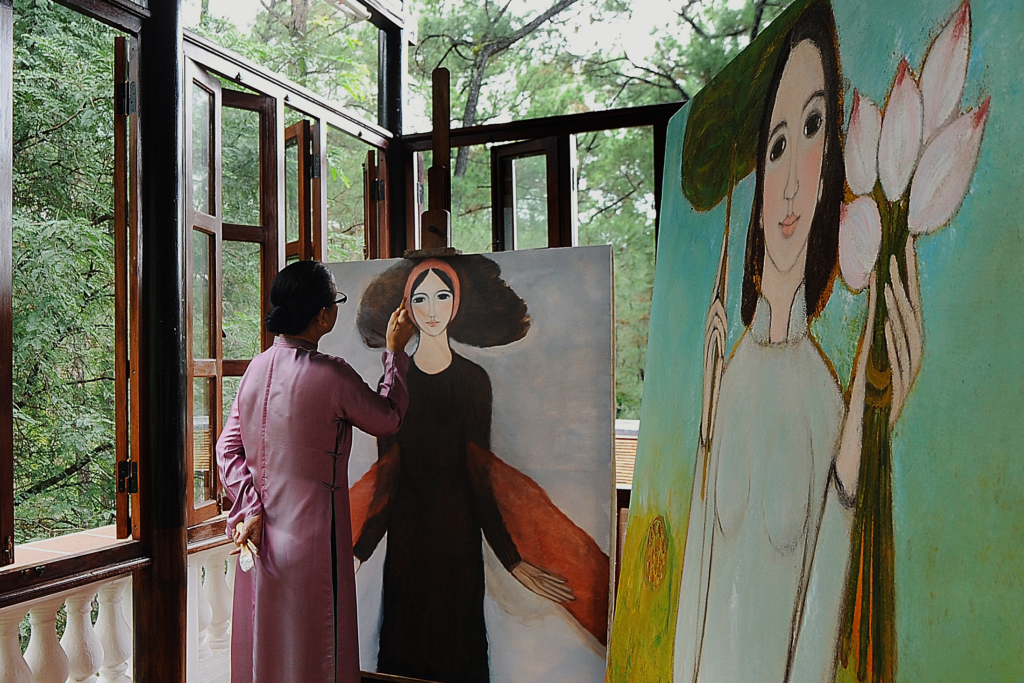

BOI TRAN (VIETNAM, B. 1957)
Guan Yin (观音)
Price on request
Boi Tran (Vietnam, B. 1957)
Guan Yin (观音)
signed and dated 'Btran 2016' (lower left)
lacquer on panel
160 x 80 cm. (62 63/64 x 31 1/2 in.)
Painted in 2016
Boi Tran’s Guan Yin (观音) departs markedly from the canonical representations of Avalokiteśvara in East Asian and Vietnamese Buddhist art, while remaining in quiet dialogue with them. Traditionally, Guanyin appears as a figure of doctrinal clarity: hieratic in posture, codified in gesture, and embedded within a visual system that signals compassion through established iconography, lotus thrones, halos, ritual attributes, and spatial hierarchies derived from temple contexts.
In contrast, this work withdraws Guanyin from the liturgical structure. The figure stands alone, frontal yet unassertive, without throne, aura, or architectural reference. The raised hand recalls traditional mudrā, yet its meaning is deliberately softened. It neither instructs nor intercedes. The gesture functions less as a symbol than as a pause, an interruption of action rather than its fulfilment.
Within Vietnamese Buddhist painting, Guanyin is often situated between celestial authority and popular devotion, balancing transcendence with accessibility. Boi Tran shifts this balance decisively toward interiority. The bodhisattva’s presence is not mediated through narrative or miracle, but through composure. Compassion is no longer performed; it is embodied as stillness.
This approach distinguishes Guan Yin (观音) from the artist’s Buddha series, where figures are typically seated, inwardly concentrated, and framed by silence that suggests meditative withdrawal. In those works, transcendence is approached through retreat, eyes lowered, bodies closed, space compressed around the act of contemplation. Here, by contrast, the standing figure introduces a subtle openness. The body remains vertical, receptive rather than sealed. Stillness persists, but it is oriented outward.
Materially, the lacquer surface reinforces this conceptual shift. Gold is present but restrained, functioning as contour rather than radiance. Blue envelops the figure without descriptive intent, dissolving distinctions between ground and atmosphere. Unlike the devotional gravitas of the Buddha paintings, where silence tends toward the sacred, the quiet here is relational, less absolute, more permeable.
Seen alongside Boi Tran’s Buddha works, Guan Yin (观音) occupies a liminal position. It neither fully belongs to devotional imagery nor to purely contemplative abstraction. Instead, it repositions Guanyin as a figure of ethical presence rather than religious authority. Compassion is not elevated; it is stabilised.
In this way, the painting reframes a familiar icon within a contemporary pictorial language, one that replaces reverence with attention, doctrine with duration. What endures is not belief, but balance, held, calmly, in place.
We are here to answer your questions and help guide you. To request a price for a particular private sale, please contact information can be found below, we will follow up with you shortly.
BOI TRAN FINE ARTS CO., LTD
Kim Son Hill, Bui Dinh Tuy Street, Thuy Xuan Ward, Hue City, Vietnam
art@boitran.com
+84 234 388 4453
boitran.com