
BOI TRAN (VIETNAM, B. 1957)
Madone des Anges (Madonna and Angels)
Price on request
Boi Tran (Vietnam, B. 1957)
Madone des Anges (Madonna and Angels)
signed 'Btran' (lower left)
lacquer on panel
100 x 100 cm. (39 1/4 x 39 1/4 in.)
Painted in 2020
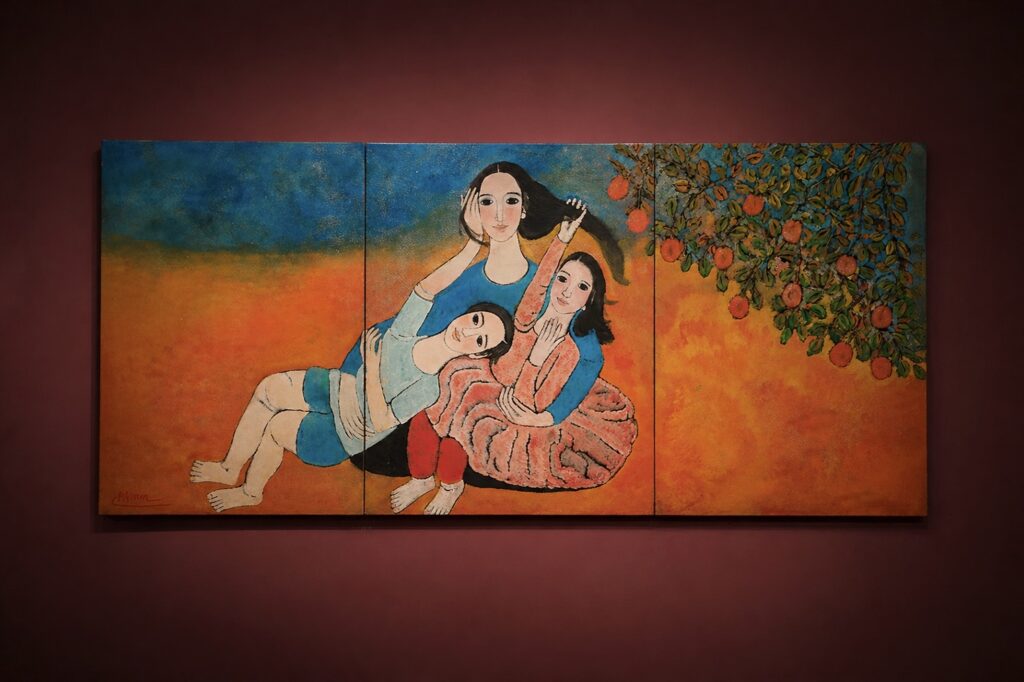
In Madone des Anges (Madonna and Angels), Boi Tran presents a scene that feels both intimate and ungraspable, the kind of image that seems at first like an allegory, yet resists being fully named. Three figures appear before us: a woman in soft blue and two angelic children who accompany her like quiet constellations. Are they her children? Are they guardians? Are they memories? The painting offers no certainty, only presence.
At the centre, the woman stands with a gentle authority, her posture calm, her face open but unreadable. She is not depicted as a symbolic Madonna, nor as a literal mother, but as something in between: a sheltering figure, a hinge between the earthly and the celestial. She gazes outward, not quite at the viewer, as though aware of a world beyond the frame, one into which the two angels seem ready to follow.
Her companions, two young angels, hover at her sides with gestures that are unmistakably tender. One raises both hands near the chest as if in a soft greeting or a half-formed prayer; the other rests lightly against her shoulder, offering a tilt of the head so trusting it feels almost weightless. Their presence recalls the ancient motif of attendants or spirits, but transformed here into something more personal, like the lingering imprint of childhood innocence held close by memory.
The blue garments of the figures echo one another, creating a unified rhythm across the panel. This is not merely a colour choice, but a compositional device: a way of binding the trio into a single emotional field. The wings, rendered with careful strokes, act as both ornament and punctuation, marking pauses of meaning within the work. And around their heads, the gilded halos shimmer, not as proclamations of divinity, but as quiet signatures of inner radiance.
Typical of Boi Tran’s lacquer practice, the surface of the painting glows with a soft luminosity. Light does not fall onto the figures; it seems to emerge from within them. Lacquer, with its layers and depths, becomes a medium of remembrance, each translucent veil of colour resembling a breath of the past, suspended in succedanea. The clouds at the lower edge reinforce this sensation of being partly in a world, partly above it. A threshold place.
The composition is built not through dramatic gesture but through an orchestration of hands. The mother’s open palm, the child’s cupped fingers, the angel leaning into her, together they form a network of gentle contact. This “ballet of hands,” to borrow a phrase, is the true architecture of the painting. It is through these gestures that the emotional structure takes shape.
And then, the question of narrative, a question the painting refuses to answer directly. The trio could be read as a mother and her children, as spirits guiding one another, or even as aspects of a single inner self: the adult self, the remembered self, and the imagined self. The ambiguity is intentional. By giving no fixed identity, Boi Tran offers a universal tenderness instead of a single story.
Painted in 2020, Madone des Anges (Madonna and Angels) revisits themes Boi Tran has long explored: feminine guardianship, spiritual composure, and the quiet endurance of love. Yet unlike many mother-and-child motifs in Vietnamese art, this work is not nostalgic. It is contemplative. It is less about returning to the past than about holding onto what remains luminous within it.
One might say that the woman here is Vietnam itself; the two angels, its children carried forward across time. Or one might see them as emissaries from a place without suffering, momentarily stepping down to offer solace. Either reading is possible, and both remain unspoken.
What Boi Tran reveals, with her habitual restraint, is something simpler:
that care itself can be an act of transcendence.
Not loud. Not miraculous. Just present.
And perhaps that is why this painting lingers. It does not proclaim heaven.
It whispers it.
We are here to answer your questions and help guide you. To request a price for a particular private sale, please contact information can be found below, we will follow up with you shortly.
BOI TRAN FINE ARTS CO., LTD
Kim Son Hill, Bui Dinh Tuy Street, Thuy Xuan Ward, Hue City, Vietnam
art@boitran.com
+84 234 388 4453
boitran.com