Boi Tran and the Sacred Trust: Guarding the Forgotten Sketches of Bui Xuan Phai and a Generation’s Art
Hai Nguyen (Van Cam Hai)
Director, Global Vietnam Wars Studies Initiative, Ash Centre, Harvard Kennedy School
Entrusted by artist Luu Ly, Boi Tran is called to a sacred task: to preserve the forgotten sketches of Bui Xuan Phai and the spirit of a generation who lived, dreamed, and created through war and silence. More than a keeper of drawings, she becomes the guardian of Vietnam’s artistic soul, where memory and destiny meet in every line.

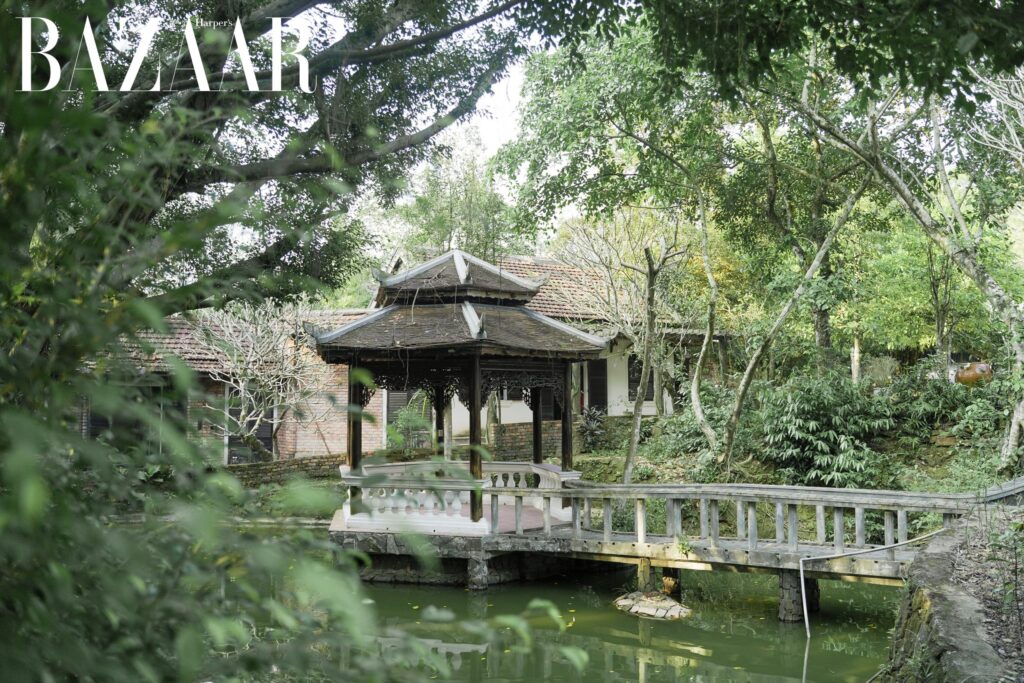
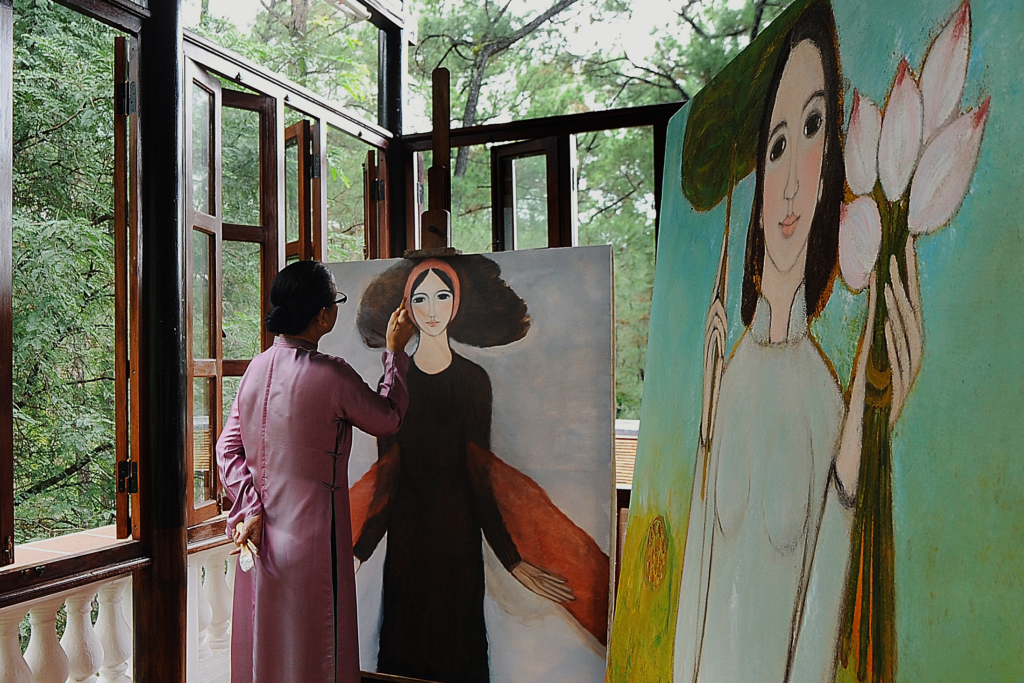
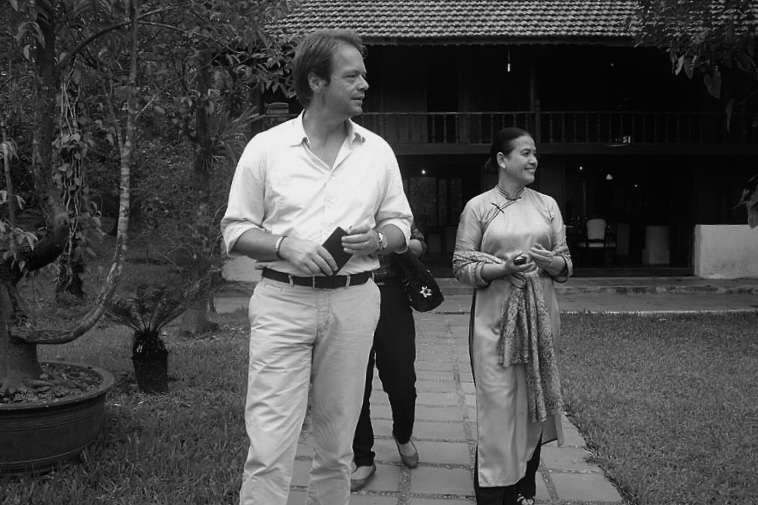
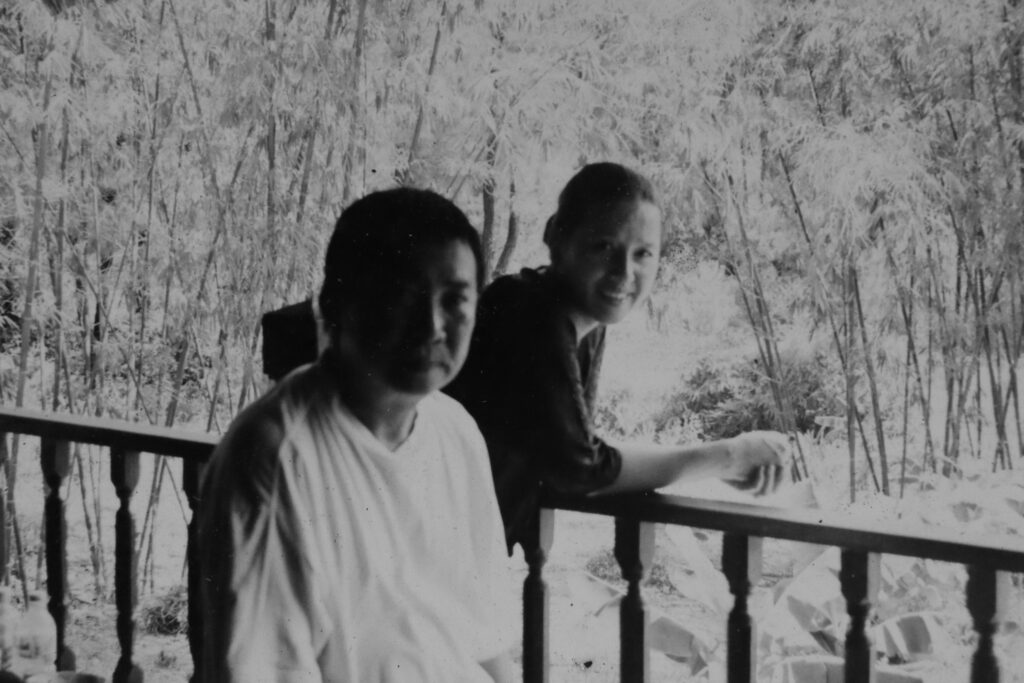
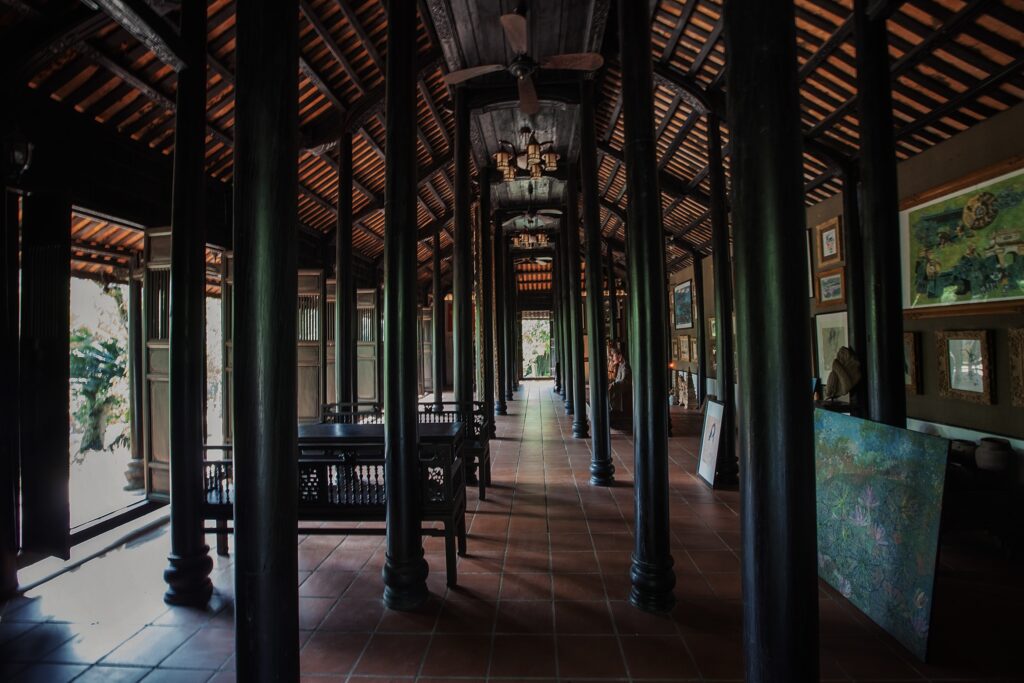
I happened upon him one rainy afternoon, in the lush green of Thien An Hill, at the Garden of Boi Tran Art Gallery in Hue, Vietnam. I was taken aback when I saw him; on that face lingered a touch of gallant grace, weathered by the long march of wartime years. The half-closed eyes of the old painter Luu Ly, eyes that had seen the world for nearly eighty years, still sparkled, alive with the colours of memory rising gently through every page of thin, yellowing paper. That fragile stack of Bristol sheets, with a weathered cover the colour of earth and ash, was a treasure to the old painter. For him, it brimmed with affection and remembrance, each page tied to the early sketches of artists who, in those days, had yet to earn fame, but whose hearts had already set out like wanderers, braving the hardships of war, dreaming only of serving Lady Art as one would serve a goddess: wholly, reverently, and without condition.
Three Unusual Pen Names Of A Master Painter
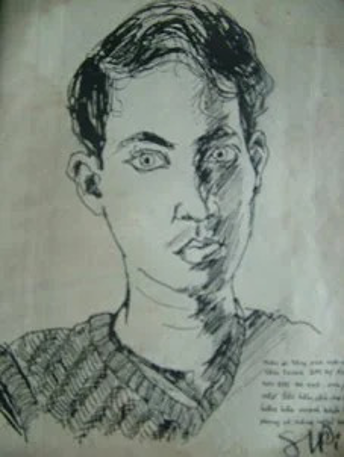
A refined face. Eyes so bright, they seem lost in wonder. Hair, soft and poetic, like drifting verses. A romantic heart-shaped wool sweater gently hugging the chest of youth. That is the self-portrait of SIPI, drawn with an iron-nib pen and Chinese ink on March 12, 1948. In the lower left corner is a handwritten dedication, in a script as composed and graceful as the face itself, infatuated and sincere:
Affectionately dedicated to Brother Viet Ho, this self-portrait by Sipi, when Sipi is far from you, you must remember him, and pray that he always remains healthy so he may serve Lady Art
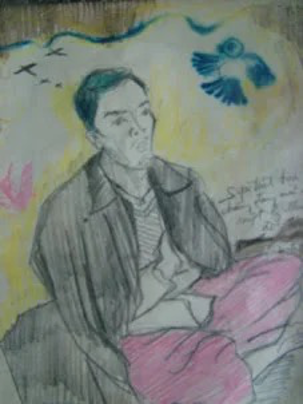
And then there was this, though the handwriting no longer carried its earlier grace, it still wandered across the page with a romantic flair, coloured by a mind steeped in thought: SIPI sits in stillness, lost in search of a theory for… Lang Bang! Sipi again. There “he” sat like a fierce silence amid a flock of fledgling birds dreaming of peace ahead, while behind him, fighter planes circled the sky in chaos. A cold-weather coat, crimson trousers bright as a Chèo performer. A face adrift in distant thought. His whole figure aglow lit with the yellow of firelight as if seeking some fragment of the future drifting just beyond reach. He called himself SIPI, but for this portrait, “he” signed as Lang Bang!
Then, another sketch, not a self-portrait this time, but a gentle rendering of Mr. Viet Ho’s kind face, framed beneath a noble, thoughtful brow. It was drawn in 1948 with coloured pencils by someone signed as Lang Thang. And yet, it was still him, “Sipi”, unmistakably so. The hand, the colours, distant yet sincere, carried a tenderness that could not be confused with anyone else!
SIPI! Lang Bang! Lang Thang! Who was this young man who dared to declare his enchanted devotion to Lady Art in the midst of smoke and fire? Who was he, with that poet’s face of youth, standing tall in self-portrait upon delicate paper, over half a century gone, yet still shining with faith and silent prayers for the mind’s communion with art? So many upheavals have passed. So many fates lost to the tides of time. Is he now gone, scattered across the far edges of land and sea? And did he ever see that dream fulfilled to “serve” Art, and be blessed in return by “her” divine grace?
Old painter Luu Ly, noticing the curiosity in my eyes, answered gently. His words fell like misted rain from the past, brushing softly through the pines of Thien An.
That one… or should we say, that Sipi, Lang Bang, Lang Thang, do you know who he was?
He’s gone now. That young man… He was Phái. Bùi Xuân Phái.
I asked in quiet disbelief.
Bùi Xuân Phái?
He said:
Yes. That was his work.
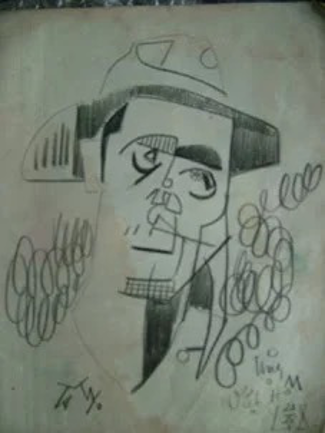
Just like you, 60 years ago, I once asked him: Why SIPI? Why Lang Bang? Why Lang Thang? Phái told me:
Sipi is a shorthand for Spitfire, the name of a British warplane which the French used during the war. If Spitfires are blazing in the sky, then here on the ground, Sipi Phái burns no less fiercely!
As for Lang Bang or Lang Thang, those names were born of our wandering years, the early days of the resistance, when Phái and all of us drifted from place to place, roaming through far-off corners of War Zone III.
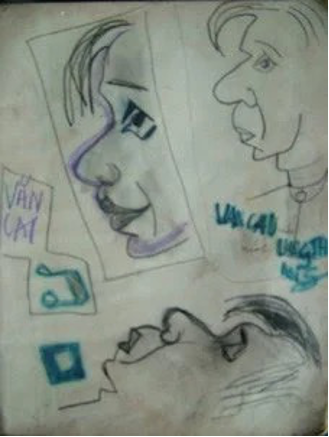
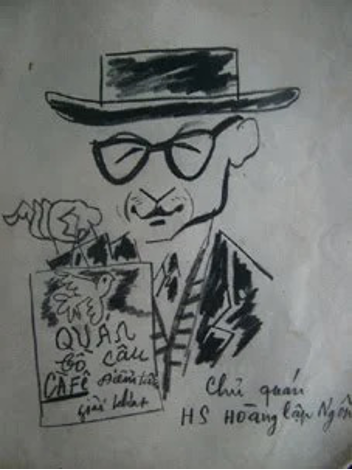
Beyond the signed sketches, old painter Luu Ly also showed me works by Bui Xuan Phai, which bore no signature, intimate portraits of fellow artists: Hoang Lap Ngon, seated beside a humble café called "Bồ Câu" (Dove Café); and Hoang Tich Chu, captured in quiet elegance. And then, most striking of all, a rare sketch of 3 faces of Van Cao. Van Cao, the composer of Vietnam’s national anthem, his image split into three states of being, each a phase of reincarnation across the surface of paper: Van Cao, contemplative and solemn. Van Cao, joyful, his eyes and lips blooming with melody. Van Cao, immersed in creation, lost in the act of composing.
Perhaps this is one of the most exceptional sketches ever made of an exceptional musician, drawn by an exceptional painter. And as if in silent dialogue with those three faces of Van Cao, there exists another trinity, three female nudes, representing three faces of Regnaut, painted not in realism but in the cubist style, by none other than Ta Ty.
Like A Trace Of Blood Sent Into The Future
According to old painter Luu Ly, after seeing Bui Xuan Phai’s sketch of three faces of Van Cao, painter Ta Ty immediately responded with a work of his own, a sketch of three faces of Regnaut, drawn as a gesture to his friend. The drawing, made in November 1948 with charcoal pencil, depicts the portraits of three women with full-bodied, Western features, standing side by side, arms entwined. In a time of war, under harsh discipline where everything served the front lines, the very act of drawing the nude female form was not only uncommon, it bordered on the audacious. And yet, amidst the fire and tension of wartime, art still dared to speak.
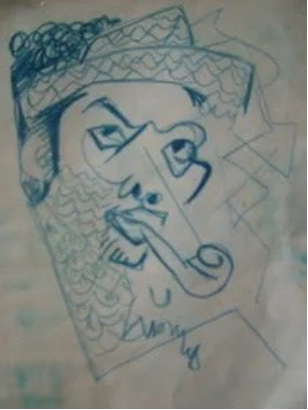
Beyond this rare nude, Ta Ty also made his presence known through several portraits, of Viet Ho, and of Luu Ly himself, portraying faces illustrated with angular tension, simplified yet striking, capturing multiple visual perspectives. Each drawing revealed the mark of a disciple of Cubism, not merely in form, but in philosophical outlook.
Also appearing in this collection of sketches is a portrait by composer Van Cao, a quick study of Mr. Viet Ho at Dong Me Street, along the road to Tam Dao. The lines are jagged and rugged, drawn in blue ink, reflecting both the image and inner state of a soldier-artist amid the circumstances of resistance. Another portrait of Viet Ho, by contrast, is executed with serene simplicity, almost photographic in its clarity, and was drawn by painter To Ngoc Van in Lỗ Từ (*) in 1947.
Alongside the master painters To Ngoc Van, Bui Xuan Phai, and Ta Ty, the sketch collection preserved by old painter Luu Ly also includes works by Le Quoc Lap, Luu Ly himself, and an artist who signed simply as Khôi. In those days, artists like Bui Xuan Phai, Ta Ty, To Ngoc Van, and Van Cao were just barely thirty, names not yet known, achievements not yet secured. And yet, with an unshakable passion for art, they created sketches filled with inner turmoil and creative boldness, testaments to the free spirit of the artist. Sketching, like the short story, distils moments of lyrical intensity, brief flashes of emotion. In those flashes, the painter catches hold of a living presence and freely renders it, capturing not only the figure but also the soul of the subject, in quiet communion with the artist’s own inner world.
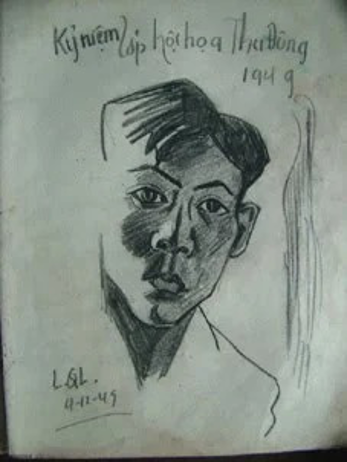
The spirit of resistance to war, the anguish it leaves behind, and a romantic devotion to life itself, these were expressed not only through sketches but also through a few aching verses of poetry. Penned, it seems, by an artist named Khôi, the lines remain inscribed like trails of blood, never fading from the sorrow-lit fire of those passing years.
A few streaks of blood red
soak this page—sent to whom?
To the one still fighting now,
or to the far-off future, soon?
...
Victory—for whom is it won?
O future! Tell us why.
Count, if you can, the drops of blood
spilled across tomorrow’s sky.Khôi, excerpted from the collection Blood Red, dated 24 July 1950
I was quietly moved and deeply grateful for the noble spirits, the quietly fierce corners of blood and tears that defined the artists of the pre-war generation. These drifting verses, these wandering sketches, so raw, so intimate, had they fallen into the hands of someone lacking empathy, without the heart to understand, they might well have ignited a so-called “literary scandal” in those years when, as Quang Dung so bravely wrote in Tây Tiến:
Scattered across the frontiers lie graves in distant exile
Off to the battlefield, they marched—never once regretting their youth.
The Origin And Return Of A Sketchbook
The figure known as Viet Ho, featured in many of the sketches, was in fact Tran Van Minh, head of the People’s Theatre Troupe under the Department of Popular Education, and eldest brother of painter Luu Ly. On the day he left Hà Nội to follow the itinerant path of his elder brother’s theatre troupe, Luu Ly was given a parting gift by their father, a painter himself. It was a notebook of Bristol paper, bound in stiff grey cardboard, the colour of earth and time. That notebook, instead of being used as a diary, gradually became a shared sketchbook, an intimate journal of images. Within its pages, artists from the troupe, Bui Xuan Phai, Ta Ty, and others, left their marks: visions of emotion, fragments of thought, quiet bursts of artistic spirit drawn in passing, yet enduring.
Knowing Luu Ly’s deep love for painting, one autumn moonlit night in the village of Đào Xá, painter Bui Xuan Phai invited him to walk along the banks of the Đáy River to the hamlet of Phù Lưu Chanh, where a Fall–Winter painting class of 1949 was being held. The class consisted of around 30 students, taught in an intensive format by master painters Luong Xuan Nhi, Ta Ty, and Bui Xuan Phai, artists who would later become pillars of modern Vietnamese art. Though the course lasted only three months, its impact was lasting. Its value lay not in its length, but in the dedication of the students and the brilliance of the teachers, who passed on not just technique, but also a spirit of artistic conviction.
The old painter Luu Ly recalled with deep affection:
I remember Phái painting a self-portrait one rainy afternoon in the village of Đào Xá, near Đại market, not far from the Hương Pagoda
He sat there in the rain, looking out, toward peace, and toward war. The place where Phái stayed was a modest house, its walls lined not with wood or canvas, but with woven mats, used to hang paintings.
In those days, at many exhibitions, we made do with what we had, mats became makeshift gallery walls, for there were no proper rooms to exhibit art.
Phái once told us:
When you draw a painting, draw in the hook too, like in that sketch of Mr. Viet Ho. That way, even if it isn’t hung, it still feels like it’s been placed on the wall for someone to admire.
As for brushes, we fashioned them ourselves. Flattened bullet casings became handles, and we clipped buffalo and cow tail hairs to make the bristles. In some villages we passed through, it was said that the cattle tails grew shorter because the artists had been there.
After completing what is considered the very first painting course of the Democratic Republic of Vietnam, Luu Ly was assigned to work in psychological operations, focusing on the printing of materials and leaflets in Inter-zone III. And through countless missions, some perilous, some near death, painter Luu Ly never parted with the sketchbook that bore the inscriptions and drawings of his revered elder artists.
The old painter Luu Ly once shared with me:
In those days, when the rain came and the cold settled in, we wore layers of paper beneath our clothes just to keep warm. And that sketchbook, I kept it in the warmest place I could find. When I had to go out into the rain, to tell you the truth, I would rather let my own body shiver and soak than let a single drop touch those thin pages. They had to be protected at all costs.
After the war ended, painter Luu Ly once again changed his line of work. He was appointed to oversee a lacquerware workshop under the Ministry of Industry and Commerce. But even then, even as the chill and rain of wartime had faded, the sketchbook never left his side. There was no more frostbite to fear, but now came the slow, silent threat of humidity, the kind that could dissolve paper, blur ink, undo time. So he roasted fragrant glutinous rice, sealed it in a plastic bag, and tucked the entire sketchbook inside, as though gently warming a heart he could never bear to let go cold.
Oh, what grace! The one who painted did so with fearless romance, and the one who preserved did so with unwavering devotion. Art endures, not only through the talent of the artist, but through the hearts of those who cherish it. Sixty years have passed. Through countless turns of fortune and history, this modest sketchbook, its spine worn, its pages faded, has become a true treasure to painter Luu Ly. For him, each humble line, each fleeting form within it, is a vast remembrance, a gift from the master painters of his youth, and one he has been blessed to carry through his life.
Sixty years have passed. Luu Ly, once a young student in that Fall–Winter painting class, now stands before me as an elder painter, nearly eighty years old. People change. Time changes. But the nineteen original sketches remain, each line still clear, each tone intact, each page quietly carrying the scent of history and the breath of those who once held the brush. They are not merely drawings. They are living echoes of a bygone time, a gallery of spirits who once wandered, dreamed, and gave themselves wholly to art.
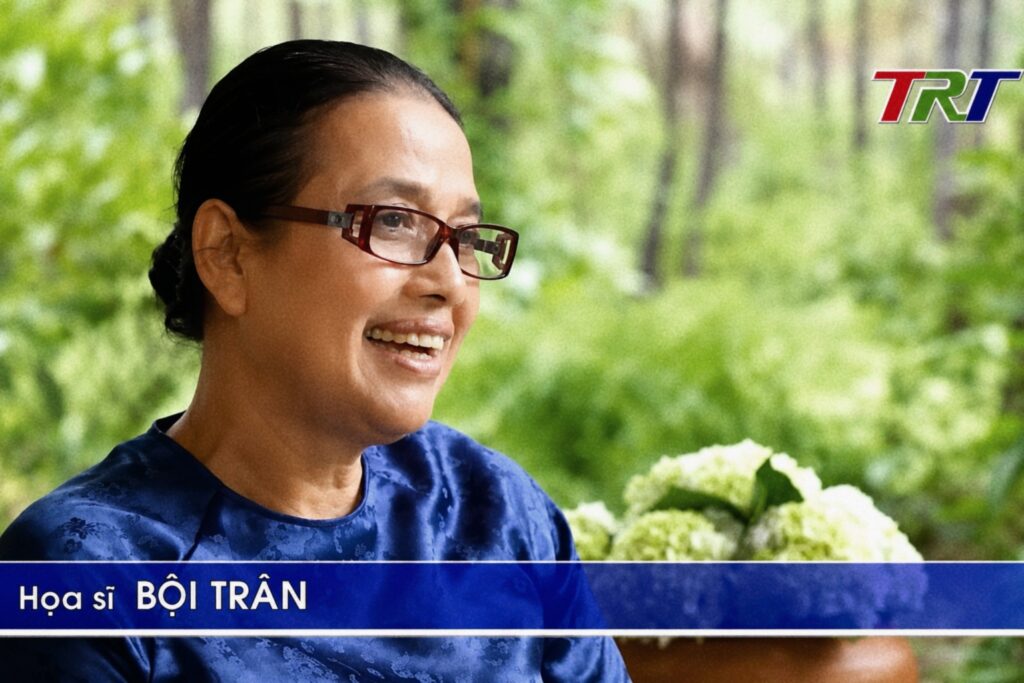
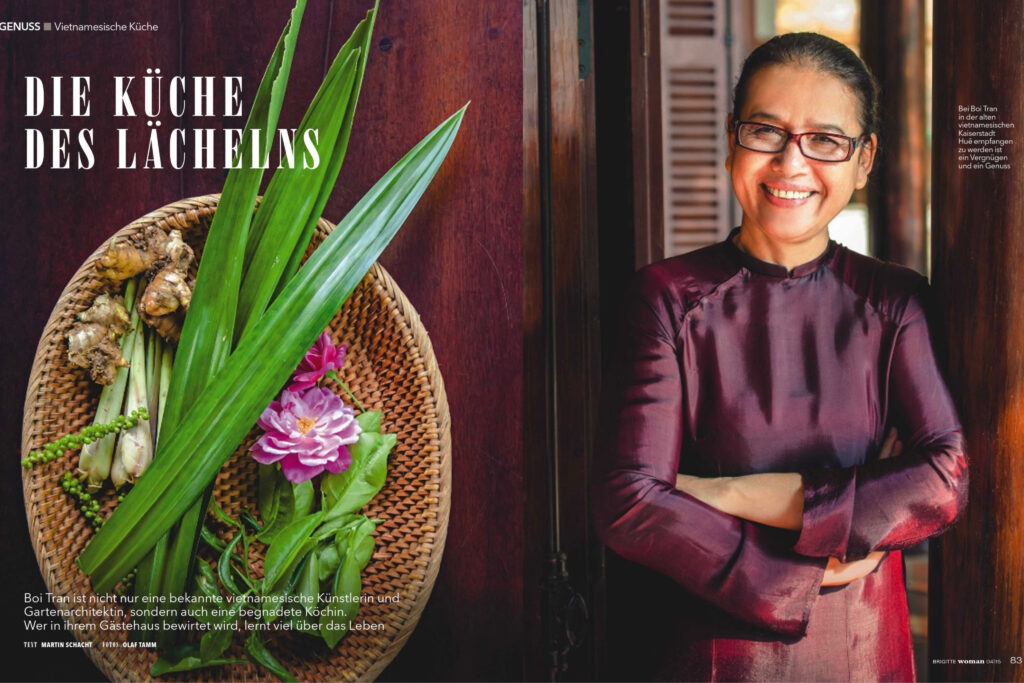
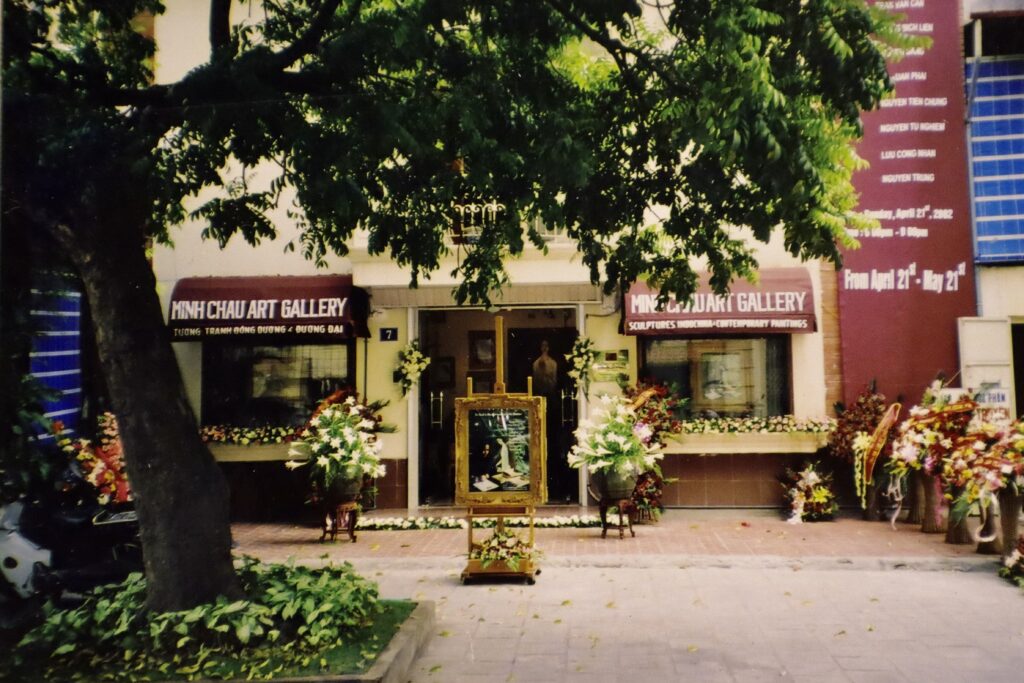
After so many long years of careful preservation, the elder painter Luu Ly has now chosen to entrust the sketchbook to Ms. Boi Tran, artist and founder of Boi Tran Gallery, nestled among the emerald pines of Thiên An Hill in Hue’s gentle autumn. What a remarkable circle of fate. The original Fall–Winter painting class, decades ago, had been organised by painter Than Trong Su, a Hue native. And now, over sixty years and many winding paths later, this sketchbook, so intimately tied to that moment in time, has returned to Hue, to the hands of another artist from the same land: Boi Tran. To her, Luu Ly has entrusted not only the sketches but also the spirit of a generation. He believes, deeply, quietly, that she will continue the journey: to protect, to honour, and to share this legacy with the world.
Lỗ Từ: In the context of the Việt Bắc Autumn-Winter Campaign of 1947, Lỗ Từ was not a specific location, but rather a part of the broader campaign, which took place in the Lô River region, including areas such as Đoan Hùng and Khe Lau.